- Introduction to Gender Role Conflict (GRC) Program
- Overall Information about GRC- Books, Summaries, & History
- Gender Role Conflict Theory, Models, and Contexts
- Recently Published GRC Studies & Dissertations
- Published Journal Studies on GRC
- Dissertations Completed on GRC
- Symposia & Research Studies Presented at APA 1980-2015
- International Published Studies & Dissertations on GRC
- Diversity, Intersectionality, & Multicultural Published Studies
- Psychometrics of the Gender Role Conflict Scale (GRCS)
- Factor Structure
- Confirmatory Factor Analyses
- Internal Consistency Reliability Data
- Internal Consistency & Reliability for 20 Diverse Samples
- Convergent & Divergent Validity of the GRCS Samples
- Normative Data on Diverse Men
- Classification of Dependent Variables & Constructs
- Authors, Samples & Measures with 200 GRC Guides
- Correlational, Moderators, and Mediator Variables Related to GRC
- GRC Research Hypotheses, Questions, and Contexts To be Explored
- Situational GRC Research Models
- 7 Research Questions/ Hypotheses on GRC & Empirical Evidence
- Important Cluster Categories of GRC Research References
- Research Models Assessing GRC and Hypotheses To Be Tested
- GRC Empirical Research Summary Publications
- Published Critiques of the GRCS & GRC Theory
- Clinically Focused Models, Journal Studies, Dissertations
- Psychoeducation Interventions with GRC
- Gender Role Journey Theory, Therapy, & Research
- Receiving Different Forms of the GRCS
- Receiving International Translations of the GRC
- Teaching the Psychology of Men Resource Webpage
- Video Lectures On The Gender Role Journey Curriculum & Additional Information
I want to welcome you to the Gender Role Conflict (GRC) webpage. The menu is below and is described in more detail on this introductory page. You can navigate to each page by clicking the corresponding box in the image below or from the menu on the left side.
Start Here: Introduction & Videos
How to Use the Webpage
Purpose, Goals, & Rationale for the Gender Role Conflict (GRC) Research Web Page
The web page’s purpose is to make the GRC research program more accessible to researchers/clinicians via the Internet. The content on this web page can be useful to psychologists, mental health clinicians as well as colleagues in other disciplines who are interested in how gender roles are conflictual for both men and women. The goal of the web page is to foster innovative thought, research and interventions on GRC that improve the lives of women, men, and transgender people.
The web page promotes a synthesis of knowledge about GRC research, by summarizing, all the past studies on specific topics in one place. Researchers and clinicians have access to what is known about GRC through the web page. Over 900 published GRC references, many categorized in 25 separate web files, help researchers and clinicians review past theories, find research studies and apply interventions relevant to their interests. Videos, lectures, commentary, and PowerPoint presentations of conceptual models explain the past GRC research and theory.
GRC is a phenomenon caused by social, technological, religious, and societal changes after the Industrial Revolution. Rapid technological and social change and feminism have stimulated the deconstruction of traditional gender roles. This change has been upsetting and traumatic for some if not many. This gender role change has been contentious for both sexes and stimulated polarization and intense debates about the meaning of gender role identity, sexual orientations and gender roles. Furthermore, sexist discrimination against women and sexual and racial minorities is intensely debated in the context of gender roles.
We live in a historical period where the damaging “patriarchal binary” of traditional gender roles dangerously conflicts with the demands and stressors in peoples’ contemporary lives, resulting in destructive and dehumanizing effects. In other words, a transitional vacuum exists in which old-world stereotypes and traditional gender roles are incompatible with mandated equality between the sexes and the acceptance that human beings can be gendered in many ways and express their sexuality in non-heterosexual orientations. From my perspective, the outcome of all of this turmoil and change with gender roles is gender role conflict. This web page reports on what we know about it.
Some History: Where We Have Been and What Is Happening Now?
In February 1972, Edmund Muskie, the frontrunner for the Democratic presidential nomination, appeared to shed tears as he responded to attacks on his wife in the press—an incident still remembered as contributing to the subsequent collapse of Muskie’s campaign, many perceived his reaction as that of a weak and less than rational man unfit to lead the nation. Forty years later, Barack Obama expressed tears of gratitude to his staff for helping him win the 2012 election. This and subsequent occasions when the president openly cried were televised repeatedly on national television, and no one, including the media, accused him of being weak or out of control. Indeed, some saw his emotionality as a sign of strength. “Before you take issue with the president’s tears,” wrote Monica Potts in the American Prospect, shortly after his anguished response to the massacre of schoolchildren and their teachers in Sandy Hook, Connecticut, “remember that Obama’s empathy is always what made him seem most presidential.” [December 14, 2012, http://prospect.org/article/obama-crying, accessed April 3, 2013] “
Over 40 years, from Muskie to Obama, there was a change in attitude about “ presidential emotion” suggesting that emotions are now considered more human instead of being interpreted as a weakness, feminine stereotype, or political liability.
A paradigm shift is occurring in America concerning our definition of masculinity, the most visible sign of which is the men who are active and engaging fathers with their sons and daughters (Pleck, 2010). As the incidents recounted above vividly demonstrate, something significant is also happening with how our society perceives male emotions. More than ever before, men are being allowed to be more vulnerable and emotional human beings. This transition is hopeful and important, but painfully slow. This web page represents a call to action to accelerate change and help men and women overcome the gender role conflict (GRC) that diminishes their human potential.
Context: What Is the GRC Research Program and Gender Role Conflict?
In a time of misinformation, propaganda, and lies, it is important to be clear about what this web page is about.
To avoid misunderstanding and promote clarity, the GRC Research Program is defined by what it does, including:
- Investigates how men have been negatively affected by restrictive and sexist gender roles causing GRC
- Documents how GRC is a serious mental health problem deserving the full attention of caring professionals.
- Creates effective programs using the gender role journey metaphor and other psychological processes to empower men, women, and transgender people to address their GRC.
Video Presentations
Video presentations on specific topics are found throughout the web page. These videos discuss GRC and the theory and research of the gender role journey. Some of the videos were produced recently and some were created in the early years of the research program.
In this introductory file, two video presentations orient you to this web page.
- The first shorter one provides information on the web page’s content and how to use it.
- The second, longer video has more detailed information including how to measure and assess GRC therapeutically, and provides information on how to help people recover from sexism and restrictive gender roles.
- Other video media on GRC, gender role journey, and other mental health issues are found throughout the web page (See Video Resources– Additional Information section).
Click here to view videos
Introduction to Gender Role Conflict and Gender Role Journey Web Page – How to use the Web page
Gender Role Conflict, Theory and Research
Important Caveats and Cautions About GRC
I want to be clear on numerous controversial points that must be highlighted.
The GRC research program does not blame men, negatively stereotype men, or criticize them for patriarchal sexism that contributes to their internalized oppression as some have implied in the past. From the beginning my goal has been different: to expose GRC so that men and women can become responsible for their problems and consequently liberate themselves from restricted gender roles and sexism.
To individuals who have suggested that documenting men’s GRC is negatively critiquing men and doing them a disservice, I say this. Researching men’s GRC is different from negatively critiquing men, blaming them, or being anti-male. The research program is not about blame but finding solutions to these complex human problems.
Additionally, women, feminists, and LBGTQ people are not blamed or scapegoated for men’s GRC. Furthermore, this web page has nothing to do with men’s rights propaganda that has blamed women and feminists for men’s problems. If anything, I seek to correct their distortions and promote a pro-feminist, gay affirmative, and positive masculinity and human perspective.
The research program has a feminist foundation and endorses equity between the sexes. Furthermore, the GRC research program is grounded in human rights, that every person should have the freedom to be whoever they are, with their gender roles and gender role identities free from patriarchal, sexist, and racist ideologies and institutional structures.
No Panacea Here: Only Contexts To Understand Changing Gender Roles & GRC
GRC is a context for understanding the complexity of gender roles in people’s lives. Many people, either consciously or unconsciously, are conflicted by changing gender roles and do not understand how GRC interacts with their gender role beliefs, identities, and sexual orientations. For some people, if not many, non-heterosexual/non binary-queer identities are disturbing because these sexual and gender lifestyles conflict with their religious, familial, or ethnic values. Therefore, all of this can stimulate intense passions about gender roles expressed in the cultural /political wars dynamics of our society that create division, polarization, hate, and violence.
Furthermore, many people are slow (or resistant) to evaluate how gender roles affect their psychological functioning and interpersonal dynamics.
GRC is one portal (i.e, opening) to help men and women explore how conceptions of sex, gender roles, and gender identity, affects their lives. Discussing how to journey with GRC can help normalize the confusion, polarization, and felt threat from changing gender roles and at the same time, help people reflect and act on their values and beliefs in ways that empower them and others. I have seen this empowerment happen with my students who have journeyed with their gender roles in my classes and workshops (Kilmartin, Addis, Mahalik, & O’Neil, 2013; O’Neil & Roberts Carroll, 1988; O’Neil 1996, 2001; Goldberg & O’Neil, 1997; O’Neil, Challenger, Renzulli, Crapser, Webster, 2013).
I do not consider GRC to be a panacea for explaining the complexity of gender roles in our society. There are many gaps in our knowledge about how human gender roles affect psychosocial development, psychopathology, and people’s everyday lives. For example, how gender role identity and sexual bonding patterns relate to GRC, and ideologies of masculinity and femininity are in their early stages of development.
Nonetheless, I do believe that GRC concepts do provide opportunities for people to explore their gender roles using an informed, evidence and data-based approach that promotes exploration and dialogue about how restrictive gender roles and sexism negatively affect people’s psychological lives.
Gender Role Conflict Theory
GRC theory discusses the complexity of restrictive gender roles in psychological, situational, developmental, multicultural, and political contexts. Theoretical models show these contexts; assumptions and hypotheses about GRC are enumerated on this web page. Both the macro-societal and micro-interpersonal contexts of GRC are discussed.
GRC has been theoretically connected to the macro-societal problems that cause societal injustices and oppression of women, sexual minorities, and people of color. The macro-societal and socio-political perspectives conceptualize human discrimination, oppression and social injustices due to patriarchal norms and institutional structures that cause GRC in most societies worldwide.
Serious social-political problems at the macro-societal-patriarchal level related to GRC include: fascism, societal violence, personal and sexual violence toward women and sexual minorities, police brutality, oppression, racism, sexism, classism, ethnocentrism, heterosexism, all forms of discrimination, poverty, famine and hunger, social injustice, conflict between nations, war, and genocide. There is considerable evidence in human history and from research that many of these problems relate to men’s gender roles and patriarchal structures that continue to oppress humans at great cost and with much suffering. Therefore, there is a lot at stake.
On a personal level, the web page is about men and women who are oppressed by restrictive gender roles and patriarchal structures. From this perspective, oppressed people are individuals who are devalued, restricted, and violated because they deviate from or conform to expected gender roles. They are discriminated against because of their: sex, gender identity, sexual orientation, race, class, ethnicity, national origin or any other diversity index. Frequently, the oppressed are those who are not part of the status quo, defined as white, male, heterosexual, middle class, Christian, Eurocentric, and American. Even this status quo patriarchal majority can be oppressed by sexism and patriarchal values because with human discrimination and oppression, psychological costs exist for both the victim and the oppressor. Moreover, the dominant white majority reap economic benefits from oppressive sexist-racist systems causing destructive capitalism and poverty. Few people, whether victims or victimizers are spared from patriarchal abuses and violence in our capitalist society. It concerns competition, power, control, money, greed, and destructive capitalism.
For more on GRC Theory, Models, Definitions, go to the GRC theory, models, definitions, & contexts by clicking here or using the left navigation menu.
The Gender Role Journey Paradigm
The Gender Role Journey Paradigm, described on this web page, encourages both men and women to live more humanly, free from the shackles of sexist gender role stereotypes and GRC.
The gender role journey is one way for people to discuss (deconstruct) sexist stereotypes and gender roles that limit their human potential and satisfaction in life.
The research program’s ultimate goal is to empower men and women regardless of how they “identify” with their sex, gender roles, gender role identity, sexual orientation, or any other difference or deviation from white, traditional and heterosexual norms.
Gender Role Conflict Research Methodology
The research program is grounded in social science methodology including psychological, quantitative, qualitative, and evidence based strategies to understand men’s problems and potentials. The Gender Role Conflict Scale (GRCS, O’Neil, Helms, Gable, David, & Wrightman, 1986)) and the Gender Role Journey Measure (GRJM, O’Neil, Egan, Owen, & Murray, 1993) assess GRC and help people resolve it. The psychometrics of the GRCS are summarized on this web page and moderators and mediators studies of GRC are reported. Preliminary research models to assess GRC are shown on this web page.
Definition of Gender Role Conflict
Defining GRC theoretically is important because misunderstanding, confusion, and conflict exist about how sex, gender, gender roles, sexual orientation, and gender role identities are understood in our society.
One of the greatest dilemmas we face is that the public lacks definitions of gender roles and how masculinity and femininity interact with their gender role identities, sexual orientations, and interpersonal processes with others. Ambiguity about gender roles and a lack of operational definitions make dialogue difficult resulting many times in avoidance, defensiveness, conflict, or denial that there is a problem at all.
Definitions of GRC and the gender role journey have evolved from a series of theoretical and research manuscripts published over 35 years (O’Neil, 1981a, 1981b, 1982, 1990, 2008, 2015; O’Neil, Wester, Heesacker, & Snowden, 2017; O’Neil et al., 1986; O’Neil et al., 1995; O’Neil & Denke, 2017; O’Neil & Egan, 1993; O’Neil & Nadeau, 1999). GRC is measured by the Gender Role Conflict Scale (GRCS; O’Neil, Helms, Gable, David, & Wrightsman, 1986) and the phases of the gender role journey are assessed by the Gender Role Journey Measure (GRJM; O’Neil. Egan, Owen, & Murry McBride, 1993).
GRC is defined as a psychological state in which socialized gender roles have negative consequences for the person or others. GRC occurs when rigid, sexist, or restrictive gender roles result in personal restriction, devaluation, or violation of others or oneself (O’Neil, 1981, 2008, 2015 ). The ultimate outcome of this kind of conflict is the restriction of the human potential of the person experiencing it or a restriction of another person’s potential. GRC has been operationally defined by four psychological domains, three situational contexts, and three personal and interpersonal experiences.
For more on GRC Theory, Models, and Definitions, go to the GRC theory, models, definitions, & contexts by clicking here or use the left menu to navigate.
Topics & Number of GRC Studies Using the Gender Role Conflict Scale
Table 1 shows the number of studies completed on GRC using the GRCS. Empirical studies that have used the Gender Role Conflict Scale (GRCS) total 644, and 299 of these studies have been published in the psychological literature. Dissertations or master theses have been completed in 346 studies. Over 160 papers have been presented at the annual APA convention meetings. Internationally, 130 empirical studies have been completed on men outside the United States; 51 have been published in the psychological literature. The GRCS has been used in over 26 different countries and translated into 20 languages.
Table 1 also shows the number of GRC studies in the following cluster categories: Overall Demographics; Diversity, Intersectionality, and Multicultural Studies; Psychological Correlates; Physical and Psychological Health; GRC Special Topics; GRC Special Groups, including vulnerable men.
| Overall Demographic Summary of GRC Studies | |
| File Topic | Number of Publications on Each GRC Topic |
| Total Number of Studies Using the GRCS | 644 |
| Published Journal Studies Using GRCS (1984-2026) | 299 |
| Dissertations Completed on GRC (1988-2026) | 347 |
| Critiques of GRC Theory & Research | 24 |
| Published GRC Research Models | 5 |
| Summary Publications of GRC Empirical Research | 7 |
| Gender Role Conflict Theory | 14 |
| Gender Role Journey Measure & Theory | 14 |
| Diversity, Intersectionality, and Multicultural Studies | |
| Identities: Racial, Ethnic, Sexual, Gender, Religious, & Political | 22 |
| African American Men | 29 |
| Hispanic American Men | 15 |
| Asian American Men | 10 |
| Mixed Race Studies | 6 |
| White Caucasian, American Men | 373 |
| International Men (Outside the United States) | 134 |
| Published International Studies | 55 |
| International Dissertations | 61 |
| International Papers Presented at APA Conventions | 18 |
| Gay Men (published studies) | 25 |
| Gay Men (dissertations) | 19 |
| Bisexual Men | 5 |
| Transgendered Men/Women | 2 |
| Woman’s Gender Role Conflict | 17 |
| Age Differences | 8 |
| SES | 2 |
| Therapy, Clients, Therapists, Counselor/Psychologist Training (journal publications) | 49 |
| Therapy, Clients, Therapists, Counselor/Psychologist Training (dissertations) | 23 |
| Psychoeducation Interventions with GRC | 16 |
| Evaluated Psychoeducational Programs with GRC | 21 |
| Psychological Correlates of GRC (1986-2013) | |
| Depression | 34 |
| Anxiety and Stress | 30 |
| Help Seeking Attitudes | 32 |
| Low Self-Esteem | 20 |
| Alcohol & Substance Abuse | 11 |
| Shame & Guilt | 6 |
| Stigma | 8 |
| Intimacy, Self-disclosure, and Relationships With Father |
12 |
| Marital Satisfaction, Family Dynamics, & Couples’ GRC |
11 |
| Discrimination & Internalized Oppression | 7 |
| Negative Attitudes, abuse, Violence Toward Women & Others |
22 |
| Attachment, Bonding, & Family Individuation | 14 |
| Hopelessness, Self-Destructiveness & Suicide | 6 |
| Traditional Attitudes Women | 5 |
| Stereotyping & Sex Role Egalitarianism | 11 |
| Biases Against Sexual and Racial Minorities | 6 |
| Men's Physical and Psychological Health Correlates of GRC | |
| Health & Medical Issues | 19 |
| Nursing & Medical Practice | 9 |
| Cancer | 7 |
| Sexuality | 12 |
| Substance Use and Abuse | 23 |
| Violence and Abuse | 34 |
| Suicide & Self-Destructiveness | 10 |
| Trauma and PTSD | 5 |
| Internalized Homophobia, Heterosexism, Homonegativity, & Anti-Gay Attitudes | 13 |
| Stigma | 18 |
| Gendered & Perceived Racism: Discrimination and Oppression | 10 |
| Coping | 11 |
| GRC Special Topics | |
| Men’s Relations with Women, Children, & Family | 10 |
| Career Development and Work | 15 |
| Muscularity & Body Image | 7 |
| Psychodynamics | 4 |
| Spiritual Wellbeing, Religious Orientation, & Fundamentalism | 10 |
| GRC Special Groups | |
| Adolescent Boys and High School Students | 25 |
| Police Officers, Fire Fighters | 6 |
| Homeless and Incarcerated Men | 8 |
| Athletes, Athletic Identity, Sports | 9 |
| Fathers-Sons -Fathering | 24 |
| Sex Offenders | 3 |
| Couples Interaction/Dynamics | 8 |
| Older Men | 14 |
| Military Men & Veterans | 7 |
What Has the Gender Role Conflict Research Found?
You are referred to five summaries of GRC research over the years for a full answer to this question (O’Neil 2008, 2013, 2015; O’Neil & Denke, 2017; O’Neil, Holmes, & Good, 1995).
Overall, the research completed indicates that men's gender role conflict is associated with a host of salient psychological problems that negatively affect both men's and women's lives. The results of the studies reviewed indicate a rather convincing case that masculinity ideology and GRC have significant relationships to psychological problems for both boys and men. The results across many studies point to significant relationships between masculinity ideology and GRC and negative psychological outcomes for both men and others. GRC and masculine ideology have been significantly correlated with negative attitudes toward women and gays; violent attitudes toward women; dangerous risk taking with sex and health issues; substance use and abuse; psychological stress and strain; negative attitudes toward help seeking; delinquent behavior; low self-esteem; hostility and aggression; higher blood pressure levels; depression; anxiety; and marital and family problems just to name a few.
A consistent pattern of significant findings suggests that GRC is related to negative interpersonal problems for men and others. The overall results indicate that GRC significantly relates to dysfunctional patterns in men’s relationships, including interpersonal restrictions, attachment problems, and marital dissatisfaction. Furthermore, couples’ dynamics, family interaction patterns, and problems with intimacy and self-disclosure have all been significantly related to GRC.
Moreover, the studies indicate that GRC is related to restrictive and negative attitudes towards women, gays, and in one study, racial minorities. Even more striking and disturbing is that GRC has been significantly correlated with positive attitudes towards sexual harassment, rape myths, hostile sexism, and self-reported sexual and dating violence towards women. The results suggest that GRC significantly relates to dysfunctional and dangerous interpersonal outcomes for men and others. The research supports what feminists have communicated for years about how restrictive gender roles are potential mental health issues for both men and women.
The web page summarizes these past studies so researchers can access the database, evaluate the studies, and create their own research or interventions.
Does GRC Research Support the Need For Compassionate Service Delivery for Boys and Men ?
Services for boys and men are needed and mandated by the research evidence that GRC relates to men’s psychological and interpersonal problems. There are few, if any, national or state wide strategic plans to meet men’s needs as they encounter changing gender roles. The lack of service delivery for men and boys perpetuates serious problems in families, schools, and our campuses. The jury is still out on whether public schools and Higher Education professionals will address boy’s and men’s problems. Telling the truth about boys and men requires a paradigm shift and higher consciousness about the effects of sexism on them. The real challenge is fully accepting that boys and men are a special group that need help and support. Whether education can change its service delivery to help vulnerable boys and men who are negatively affected by socialized sexism is unclear. How many more school shootings, acts of campus violence, rapes, male suspensions and dropouts, and gay boy suicides will it take to understand that masculinity ideologies and GRC are directly relevant to these serious problems? Is our inaction in this vital area part of our denial and backlash against men and boys? When will we fully understand that sexism has negative consequences for everyone? Can we acknowledge this without creating a zero sum game that pits men and women against each other?
I address these issues in the video “A Call to Action for More Programs and Services to Help Men and Boys."
Video link: Call to Action for Boys and Men.
Additionally, two manuscripts on helping boys are found here:
O’Neil, J.M. & Lujan, M. L. (2009). Preventing boys problems in schools through psychoeducation programming: A call to action. Psychology in the Schools. 46, 257-266.
O’Neil, J.M., Challenger, C., Renzulli, S., Crapser, B., & Webster, E. (2013). The boy’s forum: An evaluation of a brief intervention to empower middle school urban boys. Journal of Men’s Studies. 21, 191-205.
How Can the Web Page Help You?
The 25 separate web files described below can be useful to researchers and clinicians in numerous ways. Each file is briefly discussed to explain what it comprises. You can find the full information for each category in the navigation menu to the left.
Overall Information on GRC: Position Paper, Video Presentations, New Books On GRC, Interview, GRC History and Reflections
This file has overall information on GRC and includes a position paper on why GRC is important and two videos presentations on GRC. The first video summarizes the first chapter in O’Neil (2015), and the second one is a call for action for more programs and services to help men and boys.
Next, four published books on GRC are summarized including the first book on women’s GRC (Pommper, 2017). A published interview at UConn on GRC is also in this file and three publications that summarize GRC’s history over the years.
GRC Theory, Models, Definitions, & Contexts
The citations in this section identify references to the published GRC theory. GRC definitions, domains, experiences, and situational contexts are presented.
The early models and theory about GRC in the 1970s and 1980s are discussed, and the evolution of the different conceptualizations over the decades.
The references and models are relevant when theorizing how gender roles and GRC relates to men’s intrapsychic, intrapersonal, interpersonal, and situational dynamics.
Most Recent Published GRC Studies & Dissertations
The most recently published journal articles and dissertations on GRC are listed in this file. The references represent the most current topics being researched empirically. I want to identify current researchers who may be helpful to you in networking and showcase their research.
Published Journal Studies (1986- present)
All the published journal studies (n=294) using the Gender Role Conflict Scale (GRCS) are presented in this file. The references should be useful to researchers and clinicians conducting critical literature reviews, seeking documentation on GRC, or citing evidence that GRC is related to negative consequences for men and women.
Dissertations Completed (1988- present)
All the dissertations/theses (n=346) completed using the Gender Role Conflict Scale (GRCS) are presented in this file. The references should be useful to any researcher or clinician conducting critical literature reviews, seeking documentation on GRC, or citing evidence that GRC is related to negative consequences for men and women.
All Published Studies & Dissertations Listed Alphabetically
Published Journal Articles and Dissertations Using the Gender Role Conflict Scale (GRCS) – 1986-Present
Achiro, R. (2014). Modeling psychosocial factors associated with legal appearances and performing–enhancing drug use. (Doctoral dissertation, Alliant International University). Dissertation Abstract International. Proquest Dissertations, 3640248.
Acosta, A.B. (2006). Gender role conflict and psychological distress. (Doctoral dissertation, University of Houston) Dissertation Abstracts International, 66/11.
Adams, D. (2010). The relationships between gender role conflict and attitudes toward help-seeking: What is the role of maladaptive coping? (Master Thesis, Ball State University).
Adams, D.F. & Egisdottir, S. (2015). The relationship between gender role conflict and psychological help-seeking: The role of maladaptive coping. The Practitioner Scholar: Journal of Counseling and Professional Psychology. 4, 63-80.
Addelston, J. (1995). Gender role conflict in elite independent high schools. (Doctoral dissertation, SUNY Graduate School). Dissertation Abstracts International. 57/05B, 3450.
Afzal, N., Noor, S., Nadeem, R., Azhar, N., Kousar, E. (2020). Relationship between father son attachment and gender role conflict in men. Institute of Professional Psychology, Bahria University, Karachi Campus, Karachi, India.
Agoncillo, D.A., Del Rosario, J., & Nomil, M.A. (2004). Gender role conflict and person-job fit of male medical representatives. Honors Thesis, Department of Psychology, De La Salle University, Manila, Philippines.
Alexander, P.E. (1999). The relationship between masculinity ideology and gender role conflict to parenting and marital issues. (Doctoral dissertation, University of Missouri-Columbia). Dissertation Abstracts International, 59/07,3678.
Alt, M., Lewis, A.M., Lui, W.M., Vilain, E., Sanchez, F.J. (2014). On the validity of popular masculinity rating scales with gay men. Arch Sex Behavior, 43, 1547-1557.
Amato, F. & MacDonald, J. (2011). Examining risk factors for homeless men: Gender role conflict, help seeking, substance abuse, and violence. Journal of Men’s Studies, 19, 227-
Amato, F. J. (2006). Understanding male violence using gender role conflict and conformity to masculine norms: A forensic sample. (Doctoral dissertation, Boston College). Dissertation Abstracts International, 67, 334.
Amato, F.J. (2012). The relationship of violence to gender role conflict and conformity to masculine norms in a forensic sample. Journal of Men’s Studies, 20, 187-2078.
Amilhamja, A.J. (2025). Assessing the gender role conflict among faculty of Sulu State College. Journal of Environmental and Social Psychology, 2, 1, 1-16.
Amorella, B. (2016). An investigation of the relationship between gay identity, perceived social support, gender role conflict, and parent intention in childless gay men. (Doctoral dissertation, Seton Hall University), South Orange, N.J. https://scholarship.shu.edu/dissertation/2185.
Anders, R. (2019). Man your meter: the mediating roles of self-compassion and self-efficacy between gender role conflict and diabetes self-care, diabetes distress, and glucose control in men with diabetes. (Doctoral dissertation, University of Georgia), Athen, GA.
Angelini-Cooke, E. (2022). The effects of gender role conflict on help seeking attitudes for men who have sex with men (MSM) and men who have sex with men and women (MSMW) with painful receptive anal intercourse. (Doctoral dissertation, Widener University) Dissertation Abstracts International, 83,11-12, AA129163451.
Appleton, D. & Robertson, N. (2025). The effect of gender ideal adherence on career burden and help seeking in male careers of people with multiple sclerosis. International Journal of MS Cate., 27, 1-21. https://doi.org/10.7224/1537-2073.2023-073.
Applewhite, S. (2007). The relationship between gender role conflict, substance use, and sexual health behaviors of Black men: An exploratory research study of Black college men (Doctoral dissertation, Howard University) Dissertation Abstract International, 67/09, 3235528
Aqsa, S. (2019). Translation of the Gender Role Conflict Scale (GRCS-SF). Department of Social Sciences – Humanities, University of Management and Technology, Lahore, Pakistan.
Arellano- Morales, L. Liang, C.T., Ruiz, L., & Rios-Oropeza, E. (2016). Perceived racism, gender role conflict, and life satisfaction among Latino day laborers. Journal of Latino Psychology, 4, 32-42.
Arndt, J.G. (2014). Comprehending male and female levels of engagement in subsets of the national survey of student engagement: Explicating the dynamics of gender role conflict as a mediating factor for males. (Doctoral dissertation, Western Michigan University). Retrieved from ProQuest Dissertations and Theses. (Accession Order No. 36904442)
Arnold, D.M. (2018). Examining masculine gender role conflict and stress in relation to religious orientation and spiritual well-being in evangelical Christian men. (Doctoral dissertation, Biola University). Dissertation Abstract International, 78, (9-B) (E).
Baima, G.P. (2012). Spiritual well-being as a mediator/moderator between male gender role conflict and psychological distress in a veteran sample (Doctoral dissertation, University of Wisconsin-Milwaukee). Dissertation Abstract International 3533193.
Baker, K.L., Robertson, N., & Connelly, D. (2010). Men caring for wives or partners with dimentia: Masculinity, strain , and gain. Aging and Mental Health, 14, 319-327.
Baker, M. (2013). The relationship between masculine gender role conflict, emotional dysregulation, and romantic relationships. Department of Psychology, Nebraska Wesleyan University, Lincoln, NE.
Banos, N. (2017). Gender role conflict and situational context. (Masters Thesis, Western Carolina University), Psychology Department, Cullowhee, N.C.
Barecki, J. (2013). The Polish adaptation of the Gender Role Conflict Scale. (Master thesis- University of Warsaw), Warsaw, Poland.
Bates, S.G., Barnett, R.V., Brennan, M.A. & Israel, G.D. (2010). The effects of gender role conflict on adolescent and emerging adults male resiliency. Journal of Men’s Studies, 17.
Bates, S.L. (2007) Gender role conflict and resilience in adolescent and emerging adult males. Masters Thesis, Department of Psychology, University of Florida, Gainesville, FL.
Bathan, E.J. (2016). Gender role conflict and experience in close relationship among psychologically distressed men: A cross-sectional study. (Thesis, Lyceum of the Philippines University- Batangas) Batangas, Philippines.
Batty, Z. (2018). Masculinity and depression: Men’s subjective experience of depression, coping, and preferences for therapy types and conditions. (Ph.D. Dissertation) University of Western Sydney, Penrith South D C NSW, 1797, Australia. 75, (i-c), 2018. AAI10309841.
Bauman, W.L. (1998). Gender role conflict, drinking motives, and alcohol consumption in undergraduate males. (Master thesis, Department of Psychology, Washington University). Bellingham, Washington, 98225.
Bean, A.O. (2009). An examination of factors that contribute to African American inability to seek professional help. (Doctoral dissertation, Tennessee State University). Dissertation Abstract International, 69, 5012.
Beatty, A., Syzdek, M., Bakkum, A. (2006). The Saint John’s experience project: Challenging men’s perception of normative gender role conflict. Journal of Men’s Studies, 14, 322-336.
Bell, A.S., Rajendram, D., & Theiler, S. (2012). Job stress, well-being, work-life balance and work-life conflict among Australian academics. Electronic Journal of Applied Psychology, 8, 25-37.
Bergen, D.J. (1997). Gender role conflict and coping: A preliminary investigation of college males. (Doctoral Dissertation, University of North Carolina) Dissertation Abstracts International, 57/12-A, 5059.
Berger, J.M. (2002). Impact of gender role conflict, masculinity ideology, alexithymia, and age on men’s attitudes toward psychological help seeking. (Doctoral dissertation, Nova Southeastern University). Dissertation Abstracts International,
Berger, J.M., Levant, R.F., McMillan, K.K., Kelleher, W., Sellers, A. (2005). Impact of gender role conflict, traditional masculinity ideology, alexithymia, and age on men’s attitudes toward psychological help seeking. Psychology of Men and Masculinity, 6, 73-78.
Berke, D.S., Wilson, L., Mouilso, E., Speir, Z., & Zeichner, A. (2015). Isolating the gendered component of men’s physical aggression. Sex Roles, 72, 509-520.
Berko, E.H. (1994). Shyness, gender-role orientation, physical self-esteem, and male gender role conflict. (Doctoral Dissertation, University of Albany, State University of New York). Dissertation Abstracts International, 55/09, 4100.
Berlin, C. (1988). Gender role conflict, future time perspective, and contraceptive behavior among unmarried Black, White and Hispanic adolescent fathers and their nonfather peers. (Doctoral dissertation, New York University). Dissertation Abstracts International, 49/10, 2940.
Bevan, N. (2010). Psychological help seeking: Understanding men’s behavior. (Doctoral Dissertation, The Univesity of Adelaide, School of Psychology, Australia.
Bingham, T.A., Harawa, N.T., Williams, J.K., (2013). Gender role conflict among African American men who have sex with men and women: Associations with mental health and sexual risk and disclosure behaviors. American Journal of Public Health, 103, 127-133.
Birthistle, I. (1999). Male gender role conflict, coping skills, and hopelessness. Eisteach, Irish Association for Counselling and Therapy, Summer, 2-8.
Bjerke, A. & Skyllingstad, Y.E. (2002). Gender Role Conflict Scale in Sweden. Master Thesis (Institute of Psychology, Lunds University), Lund, Sweden, Psykologexamensuppsats, 4, 9.
Blashill, A. J. & Vanderwal, J.S. (2009). Mediation of gender role conflict and eating pathology in gay men. Psychology of Men and Masculinity, 10, 204-217.
Blashill, A.J. & Hughes, H.H. (2009) Gender role and gender role conflict: Preliminary considerations for psychotherapy with gay men. Journal of Gay and Lesbian Mental Health, 13, 170-186.
Blazina, C. & Jackson, S. (2009). Assessing for a pluralistic sense of masculinity: The Masculinity Across Role Scale (MARS), the Gender Role Conflict Scale – Adolescent (GRCS-A), and boy’s scores of depression. In J.H. Urlich & B.T. Cosell (Eds.) Handbook of Gender Roles. Orlando, FL.: Nova Science Publishers.
Blazina, C. & Marks, I. (2001). College men’s affective reactions to individual therapy, psychoeducation workshops, and men’s support group brochures: The influence of gender role conflict and power dynamics upon help seeking attitudes. Psychotherapy, 38, 297-305.
Blazina, C. & O’Neil, J. M. (2010). Gender role conflict. In R. J. R. Levesque (Ed.) Encyclopedia of Adolescence, (pp. 77-82), New York, New York: Springer .
Blazina, C. & Watkins, C.E. (1996). Masculine gender role conflict: Effects on college men’s psychological well-being, chemical substance usage, and attitudes toward help- seeking, Journal of Counseling Psychology, 43, 461-465.
Blazina, C. & Watkins, C.E. (2000). Separation/individuation, parental attachment, and male gender conflict: Attitudes toward the feminine and the fragile masculine self. Psychology of Men and Masculinity, 1, 126-132.
Blazina, C., Cordova, M., Pisecco, S., Settle, A. (2007). Gender Role Conflict Scale for Adolescents: Correlates with masculine ideology, Thymos: Journal of Boyhood Studies, 1, 191-204.
Blazina, C., Pisecco, S., & O’Neil, J.M. (2005) An adaptation of the Gender Role Conflict Scale for Adolescents: Psychometric issues and correlates with psychological distress. Psychology of Men and Masculinity, 6, 39-45.
Blazina, C., Settle, A.G. & Eddins, R. (2008). Gender role conflict and separation individuation difficulties: Their impact on college men’s loneliness. The Journal of Men’s Studies, 16, 69-81.
Blazina, C.D. (1997). Masculine gender role conflict: Effects on college men’s scores of psychological well-being, chemical substance usage, and attitudes towards help-seeking. (Doctoral dissertation, University of North Texas). Dissertation Abstracts International, 57/07, 4778.
Boespflug, S.A. (2005). Attitudes of future male business managers toward seeking psychotherapy. (Doctoral dissertation, University of Iowa). Dissertation Abstracts international, 65, 12, 6642.
Boghokian, T., Cruz, N., Hickman, S.J., LaFollette, J.R., Shea, M. & Wong, Y.J. (2011). The inventory of subjective masculinity experiences” Development and psychometric propereties. The Journal of Men’s Studies, 19, 236-
Boisjolie, J. (2013). Gender role conflict and attitudes toward seeking help. (MSW Clinical Research Paper, St. Catherine University and University of St. Thomas). St. Paul, MN. Rankin, Z.J. (2013). Conformity to masculine norms, gender role conflict, and relationship satisfaction in inter-male friendships. Unpublished Thesis, Humboldt State University.
Booth, N.R. (2021). Traditional masculinity ideology, conformity, gender role conflict, and protective traits: A testable model based on the gender role strain paradigm. (Doctoral dissertation, University of Southern Alabama) Dissertation Abstracts International. 82, (2-B), AA 128027077.
Borthick, M.J. (1997). Gender role conflict and suicidal ideation in an adolescent and young adult population: Age 18-24 year-old. (Doctoral dissertation, Tennessee State University). Dissertation Abstracts International 58, 4437.
Botticelli, L. (2016). An exploratory study of men’s restrictive emotionality and patterns of romantic attachment. Research Methods Manuscript. The New School for Social research, New York City, N.Y.
Bouroughs, M. & Thompson, J.K. (2014).Correlates of body depilation: An exploratory study into the health implications of body hair reduction and removal among college-aged men. American Journal of Men’s Health, 8, 217-223.
Brahmana, K.M., Suryanto, S., Suyanto, B. (2019). Gender role conflict model of pastors’ husbands at Batak Karo Protestant Church, Interpersona, 13, 127-143.
Brahmana, Karina. (2019). Pengaruh Ideologi Maskulin Terhadap Konflik Peran Gender Pada Laki-Laki Suku Batak Karo. Jurnal Psikologi Universitas HKBP Nommensen. 6. 10-20. 10.36655/psikologi.v6i1.71.
Braverman, D. (1990). Gender role conflict in fraternity men. (Doctoral dissertation, University of Iowa). Dissertation Abstracts International, 52/03, 844.
Breiding, M. J. (2003). The role of observed hostility and observed dominance as mediators of husband’s gender role conflict and outcome for wives. Doctoral dissertation, University of Notre Dame) Dissertation Abstract International, 64, 63222.
Breiding, M. J. (2004) Observed hostility and observe dominance as mediators of the relationship between husbands’ gender role conflict and wife outcomes. Journal of Counseling Psychology, 51, 429-436.
Breiding, M., Windle, C.R. & Smith, D.A. (2008). Interspousal criticism: A behavioral mediator between husband’s gender role conflict and wife’s adjustment. Sex Roles, 59, 880-888.
Brennan, M. (2021) “I know it’s not my fault, but it’s my fault”: The impact of experiences of sexual victimization on men’s gender role conflict and acceptance of sexual violence myths. University of Kansas ProQuest Dissertations & Theses, 2021. 28000925.
Brewer, A.M. (1998). The relationships among gender role conflict, depression, hopelessness, and marital satisfaction in a sample of African-American men. (Doctoral dissertation, Kent State University). Dissertation Abstracts International, 59/06, 3049.
Brooks-Harris, J.E., Heesacker, M., Mejia-Millan, C. (1996). Changing men’s male gender-role attitudes by applying the elaboration likelihood model of attitude change. Sex Roles, 35, 563-580.
Brown, L.B. (2015). Examining masculine gender role conflict and stress in relation to religious orientation, spiritual well-being, and sex-role egalitarianism in Latter-day Saint men. (Doctoral dissertation, Brigham Young University). Provo, UT. Retrieved from ProQuest Dissertations and Theses. (Accession Order No. 3732764).
Bruch, M.A. (2002). Shyness and toughness: Unique and moderated relations with men_s emotional inexpressiveness. Journal of Counseling Psychology, 49, 28-34.
Bruch, M.A., Berko, E.H., Haase, R.F. (1998). Shyness, masculine ideology, physical attractiveness, and emotional inexpressiveness: Testing a mediational model of men’s interpersonal competence. Journal of Counseling Psychology, 45, 84-97.
Brunet, E. (2007). The relationship between gender role conflict, shame, and problem solving in Victorian aboriginal men. Unpublished paper, Monash University, Melbourne, Australia.
Bryce, D.M. (2012). Predicting men’s relationship satisfaction with men through internalized homonegativity and restricted emotionality (Doctoral dissertation, University of La Verne). Pro Quest Dissertation & Theses Database. (UMI No. 3535704).
Buckner, D.R. (1999). Masculinity, gender role conflict, and male-male friendships (Doctoral dissertation, Tennessee State University). Dissertation Abstracts International, 62, 1639.
Bun, L. C. (2006).A meta-analytic review of male gender role conflict and its consequences. (Masters thesis, The Chinese University of Hong Kong) Hong Kong, China.
Burke, K. (2000). Gender role conflict and psychological well-being: An exploration in men enrolled to attend an initiatory weekend. (Master thesis, Human Service Psychology – Clinical, University of Maryland (Baltimore County). Baltimore, Md. 21227.
Burkley, M., Wong, Y.J., Bell, A.C. (2016). The Masculinity Contingency Scale (MCS): Scale development and psychometric properties. Psychology of Men and Masculinity, 17, 113-125.
Burroughs, J. (2021). Depression and gender role conflict in midlife men: What can the TAT tell us about their experiences? (Doctoral dissertation, Fielding Graduate University),
Bursley, K.H. (1996). Gender role strain and help seeking attitudes and behaviors in college men. (Doctoral dissertation, Virginia Commonwealth University). Dissertation Abstracts International, 56/10, 3884.
Butchko, M.S. (2017). Repairing the broken mirror: Understanding men’s muscularity focused body image concerns through the lens of gender role conflict and self-comparison. (Doctoral dissertation, University of Nebraska), Lincoln, NE. Retrieved from ProQuest Dissertations and Theses. (Accession Order No. 10254006).
Butler, M (2005). A gender comparison of relationships between gender role conflict and depression, anxiety, and stress in Australian university students. Psychology laboratory Report, RMIT University, Australia.
Cachia, P. (2001). The interplay of gender role conflict and adult attachment. (Master thesis, University of Malta), Department of Psychology, University of Malta, Malta.
Cadenhead, L.R. (2002). Adolescent gender role conflict in a clinical population. (Doctoral dissertation, University of Houston). Dissertation Abstracts International, 63, 3001.
Calderon, V. (2015). Adaptation and properties of the gender role conflict scale in college students. Clincial Psychology, Pontificia Catholic University of Peru, Lima, Peru.
Calton, J.M. Heesacker, M., Perrin, P.B. (2014). The elusiveness of progressive masculinity: Gender differences in conceptualization of nontraditional gender roles. Journal of Gender and Power, 2, XXXXXX.
Campbell, J.L., & Snow, B.M. (1992). Gender role conflict and family environment as predictors of men’s marital satisfaction. Journal of Family Psychology, 6, 84- 87.
Carrillo, M. (2015). Gender role conflict and men’s attitudes towards mental health counseling, alcohol use and depression. (Master Thesis, Winona State University), Winona, M.N.
Carrington, G.E. (2004). Predictors of African American male utilization of individual counseling services. (Doctoral dissertation, Kent state University). Dissertation Abstracts International, 65, 1675, 3133683.
Carter, R.T., Williams, B., & Juby, H. L. (2005). Racial identity as mediator of the relationship between gender role conflict and severity of psychological symptoms in Black, Latino, and Asian men. Sex roles, 53, 473-486.
Cartier, C.R. (2009). Asian American men’s gender role conflict: An investigation of racism-related stress. University of Wisconsin-Stout, Master Theses, Menomonie, WI. 1-73.
Celentana, M.A. (2000). Men’s gender role adherence, relational partner’s psychological well-being, and constructivist measures of intimacy. (Doctoral dissertation, Miami University). Dissertation Abstracts International, 61, 5555.
Chamberlin, W. (1993). Gender role conflict as a predictor of problem solving, leadership style, authoritarian attributes, and conflict management attitudes. (Doctoral dissertation, University of Iowa). Dissertation Abstracts International, 52/03, 844
Chamykarpour, M.A., Pourshahbaz, A., Dolatshahi, B., Moshtagh, N. (2012). Gender role conflict and seven factors model of personality among Iranian men. Tehran, Iran: University of Social Welfare and Rehabilitation Sciences.
Chamykarpour, M.N., Pourshahbus, A., Dolatshahi, B., Moshtagh, N. (2012). Psychometric properties of the Persian version of the Gender Role conflict Scale (GRCS). Knowledge & Research in Applied Psychology. 13, (Continuous No. 47).
Chan, R.K. & Hayashi, K. (2010). Gender roles and help-seeking behavior and promoting help among Japanese men. Journal of Social Work, 10, 243-362.
Chase, L. (2000). Gender role conflict and the level of physical violence: A study of physically abusive men (Doctoral dissertation, Catholic University of America) Dissertation Abstracts International, 61, 2465.
Choi, H., Kim, B., & Kim, J. (2005). Men’s extroversion, neuroticism, gender role, gender role conflict, and subjective well-being. The Korean Journal of Counseling, 6, 61-73.
Choi, H., Kim, J., Hwang, M., & Heppner, M.J. (2010). Self esteem as a mediator between instrumentality, gender role conflict, and depression in male Korean high school studetns. Sex Roles, 63, 361-372.
Choi, N., Herdman, K.,Fuqua, D.R., Newman, J.L. (2011). Gender role conflict and gender role orientation in a sample of gay men. The Journal of Psychology, 145, 507-519.
Christensen, M., Purkis, N., Morgan, R., Allen, C. (2021). Does the nursing curriculum influence feelings of gender role conflict in a cohort of nursing degree male students? Br J Nurs. 2021- Sept 23, 30 (17):1024-1030.17.1024.
Christensen, M.I. (2001). Gender role conflict in adolescent males. (Doctoral dissertation, Chicago School of Professional Psychology). Dissertation Abstracts International, 63, 2051.
Christy, S.M., Mosher, C.E., Rawl, S.M. (2014). Integrating men’s health and masculinity theories to explain colorectal cancer screening behavior. American Journal Men’s Health, 8 (1), doi: 10.1177/1557988313492171.
Chung-Hee, W. & Seung-Yeon, Y. (2021). The effects of the gender sensitivity, the gender role conflict on nursing professionals in nursing students. The Journal of Korean Society for School & Community Health Education, 22, 41-54.
Closson, K., Hatcher, A., Sikweyiya, Y., Washington, L. Mkhwanazi, S., Jewkes, R., Dunkel, K., & Gibbs, A. (2020).Gender role conflict and sexual health and relationship practices amongst young men living in urban informal settlements in South Africa. Culture, Health, and Sexuality. DOI 10, 1080/13691058.2019. 1568578.
Cohn, A. & Zeichner, A. (2006). Effects of masculine identity and gender role stress on aggression in men. Psychology of Men and Masculinity, 7, 179-190.
Cohn, A.M. Seibert, L.A., Ziechner, A. (2009). The role of restrictive emotionality, trait anger, and masculinity threat in men’s perpetration of physical aggression. Psychology of Men and Masculinity, 10, 218-224.
Cohn, A.M., Jakupcak, M., Seibert, L.A., Hildebrandt, T.B., & Zeicher, A. (2001). The role of emotion dysregulation in the association between men’s restrictive emotionality and use of physical aggression. Psychology of Men and masculinity, 11, 53-64.
Cohn, A.M., Zeichner, A., & Seibert, L.A. (2008). Labile affect as a risk factor for aggressive behavior in men. Psychology of Men and Masculinity, 9, 29-39.
Cole, B.P. & Ingram, P.B. (2020). Where do I turn for help? Gender role conflict, self-stigma, and college men’s help of seeking for depression. Psychology of Men and Masculinities, http://dx.doi.org/10.1037/men0000245.
Cole, B.P., Baglieri, M., Ploharz, S., Brennan, M., Terns, M., Patterson, T., Kuznia, A. (2019). What’s right with Men?: Gender role socialization and men’s positive functioning. American Journal of men’s Health. 13 (1): 1557988318806074.
Coleman, A., O’Neil, J.M., Caldwell, C.H., Ferris, A.M. (2019). Black fathers matter: The role of paternal closeness on adolescent male obesity. Psychology of Men and Masculinities, 20, 174-181. http://dxdoi/org/10.1037//men0000183.
Coleman, A., O’Neil, J.M., Ferris, A.M. (2019). The mediation effect between everyday discrimination, gender role conflict, emotional eating, and obesity in African American fathers and sons. Psychology of Men and Masculinities, 20, 182-193. Http//dxx.doi.org/10.122037/m3n00002012.
Coleman, A.S. (2015). The role of fathers in masculinity and obesity in African American adolescent males. (Doctoral dissertation, 907. Http://opencommons.uconn.edu/dissertration/907.
Columbo, J.R. (2008). Personal dimensions of masculinity and psychological well being of stay-at-home fathers. Doctoral Dissertation, Walden University, Minneapolis, MN.
Coonerty-Femiano, A. (2009). Developing and evaluating an anger management intervention for boys: What does gender have to do with it? (Doctoral dissertation, Boston College). Dissertation Abstracts International, 69, 577.
Cortese, J.R. (2003). Gender role conflict, personality, and help seeking. (Doctoral dissertation, University of Southern California). Dissertation Abstracts International, 64, 4609.
Cournoyer, R.J. & Mahalik, J.R. (1995). A cross- sectional study of gender role conflict examining college- aged and middle-aged men. Journal of Counseling Psychology, 42, 11-19.
Cournoyer, R.J. (1994). A developmental study of gender role conflict in men and its changing relationship to psychological well- being. (Doctoral dissertation, Boston College). Dissertation Abstracts International, 54/12, 6476.
Courtenay, W.H. & McCreary, D.R. (2011) Masculinity and gender role conflict: How they influence the likiehood that men will engage in multipe high-risk behaviors. In W. H. Courtenay Dying to be men: Psychosocial environmental and biobehavioral directions in promoting the health of men. New York: Routledge.
Courtney, A. (2019). The effect of age on male body image when controlling for gender role conflict. Institute of Art, Design + Technology. Thesis. https://hdl.handle.net/10779/iadt.25226474.v1
Covell, A. (1998). Characteristics of college males who are likely to sexually harass women: A test of a mediated model. (Doctoral dissertation, University of Southern California). Dissertation Abstracts International, 60, 2400.
Cox, C.K. (2008). Gender role conflict and acculturation as predictors of help-seeking attitudes in Mexican-American men. (Doctoral dissertation, Alliant International University). Dissertation Abstracts International, 69, 08, 3324382.
Coyne, A. (2015). Gender role conflict, fathering attitude and participation in parenting interventions. (Master thesis, University of Southern Queensland), Queensland, Australia.
Cranswick, I., Tod, D., Clarke, P., Jones, A., (2023). Exploring the impact of athletic identity on gender role conflict and athlete injury fear avoidance in male English professional academy football players. Science Medicine Football, doi: 10.1080/24733938.2023.2224293.
Crapser , B. (2018). Relationship of counselor trainees’ gender role ideologies on clinical judgement with male clients. Doctoral dissertations. 1715. https//opencommons.uconn.edu/dissertation/1715.
Cusack, J., Deane, F.P., Wilson, C.J., & Ciarrochi, J. (2006). Emotional expression, perceptions of therapy, and help seeking intentions in men attending therapy services. Psychology of Men and Masculinity, 7, 69-82.
Czientze, L. (2015). Do males seek help? Role of attachment, gender role conflict and disclosure. (Thesis, Department of Psychology, Help University), Kuala Lumpur, Malaysia
Daltry, R. (2009). The impact of gender role conflict on the quality of life in female athletes, Doctoral dissertation, LaSalle University. Philadelphia, PA.
Daltry, R. (2013). The impact of gender role conflict on the quality of life in female athletes. The International Journal of Sport and Society 3 (2), 49-65.
Danforth, L. (2016). The effects of gender role conflict stigma, and social support on help seeking in male service providers. (Doctoral dissertation, University of Wisconsin- Milwaukee), Milwaukee, MI. Retrieved from ProQuest Dissertations and Theses. (Accession Order No. 10153182).
Daoultzis, K. C., & Kordoutis, P. (2023a). Gender Role Conflict, Gay Identity, Relationship Love Types and Relationship Satisfaction in Greek Gay Men: A Path Model. The Journal of Men’s Studies, 31, 3, 449-477, 10608265231177432. https://doi.org/10.1177/10608265231177432.
Daoultzis, K. C., & Kordoutis, P. (2023b, ). Psychometric properties of the Gender Role Conflict – Short form (GRC-SF) in straight and gay Greek men. Interpersona: An International Journal on Personal Relationships. 17 (2),143-160.
Daoultzis, K. C., & Kordoutis, P. (2024a). A pilot study testing a new visual stimuli database for probing men’s Gender Role Conflict: GRASP (Gender Role Affective Stimuli Pool). Journal of Homosexuality. 71, 72-95 DOI: 10.1080/00918369.2022.2104147
Daoultzis, K. C., & Kordoutis, P. (2024b). The bigger picture: The effect of context on Gender Role Conflict. Psychological Reports. Psychological Reports. 127 (2), 747-785.
Daoultzis, K.C. (2022). Gender role conflict in Greek straight and gay men: A quasi experimental, a sociocognitive, and sociopsychological approach. (Doctoral dissertation, Department of Psychology. Panteion University, Athens, Greece.
Davids, C.M. (2015) Sexual objectification and gender role conflict as predictors of drive for muscularity: A test and extension of objectification theory. (Doctoral dissertation, University Missouri-Kansas City), Pro Quest Dissertations and Theses, 3701178
Davids, C.M., Watson, L.B., Gere, M.P. (2019). Objectification, masculinity, and muscularity: A test of objectification theory with heterosexual men. Sex Roles, 80, 443-457. http://doi.org/10.1007/slll99-018-0940-6.
Davies, P.A. (2017). The relationship between gender role conflict, marital and life satisfaction among Ghanaian couples. Federal State Autonomous Educational Institution of Tertiary Education. Department of Psychology, Moscow, Russia.
Davis, F. (1988). Antecedents and consequents of gender role conflict: An empirical test of sex-role strain analysis. (Doctoral dissertation, Ohio State University). Dissertation Abstracts International, 48/11, 3443.
Davis, J.M. (2012). Psychological help seeking among Latino males: Machismo, caballerismo, and gender role conflict. (Dissertation Abstracts, University of La Verne). Dissertation Abstract International. 3536343.
Davis, J.M., & Liang, C.T.H. (2015). A test of the mediating role of gender role conflict Latino masculinities and help-seeking attitudes. Psychology of men and masculinity, 16, 23-32.
Davis, T. L. & Liddell, D.L. (2002). Getting inside the house: The effectiveness of a rape prevention program for college fraternity men. Journal of College Student Development, 43, 35-50.
Davis, T. L. (2002). Voices of gender role conflict: The social construction of college men’s identity. Journal of College Student Development, 43, 508-521.
Davis, T.L. (1997). The effectiveness of a sex role socialization-focused date rape prevention program in reducing rape-supportive attitudes in college fraternity men. (Doctoral dissertation, University of Iowa). Dissertation Abstracts International, 58/05, 1599.
Dax, V., Ftanou, M., Tran, B., Lewin, J., Wiley, J.F. (2023). Malignancy, masculinities, and psychological distress: Comparisons made between men and testicular cancer and healthy controls. Psych-Oncology, 33, 1, e6262, http://online library.wiley.com/doi/10.1002/pon.6262.
de Visser, R. (2009). Young men, masculinity, and alcohol. In A. Broom & P. Tovey (Eds.) Men’s health: Body, identity, and social context. New York: Wiley
Defranc, W. & Mahalik, J.R. (2002). Masculine gender role conflict and stress in relation to parental attachment and separation. Psychology of Men and Masculinity, 3, 51-60.
Del Pino, H.E. Steers, W.N., Lee, M., McCullen, J., Hays, R.D. Harawa, N.T. (2021). Measuring gender role conflict, internalized stigma, and racial and sexual identity in behaviorally bisexual Black men. Archives of Sexual Behavior, http://link. Springer.com/article/10.1007/s10508-021-01925-w# citeas.
Dillon, A. (2024). The impact of gender segregation in Irish schools on male gender role conflict. (Doctoral dissertation, Alliant International University). ProQuest Dissertations & Theses. 2024 31297092.
Dillon, M.G. (2003). Masculine gender role conflict and stress: Assessment and relation to psychological stress (Doctoral dissertation, University of Missouri – Columbia). Dissertation Abstract International, 64, 6325.
Dodson, T. (2001). Male career compromise process: Career traditionality, male role norms adherence, gender role conflict, and job satisfaction. (Doctoral dissertation, University of Virginia). Dissertation Abstracts International, 62, 4071.
Dodson, T.A. & Borders, L.D. (2006). Men in traditional and nontraditional careers: Gender role attitudes, gender role conflict, and job satisfaction. Career Development Quarterly, 54, 283-296.
Dogan, J.N., Stevens-Watkins, D., Miller-Roenig, K., Marshburn, C.K., Moody, M.D. (2022). Experiencing burnout: John Henryism, gender role conflict, and anxiety among incarcerated Black men. Int. J. Offender Ther Comp Criminal, doi: 10. 1177/0306624X221124841.
Dolling, L. (2008). Examining the relationship between martial status, masculinity, optimism, and men’s professional and non-professional help seeking. School Psychology, Psychiatry, & Psychological Medicine, Monash University, Churchill, Victoria, Australia.
Donaldson, S. (2015). Women seek help-men die. An investigation into the effects of middle aged men’s self-perceived gender roles identity and their experience with depression, (Doctoral dissertation: University of Dundee) Dundee, Scotland.
Driver, R. , Cortopassi, A.C., El-Krab, R., Eaton, L.A., Kalichman, S.C. (2022). Examining stigmatizing beliefs about PREP use Black sexual minority men: A test of explanatory mechanisms. Psychology of Men and Masculinities. 23, 1, 26-34.
Drost, C.M. (2005). Male gender role conflict in older men (Doctoral Dissertation, Columbia University). Dissertation Abstracts International, 65/09, 4825.
Dugas, A. (2015). Male gender role conflict and relationship satisfaction: A Dyadic analysis. Thesis, New College of Florida, Sarasota, FL.
Dukes, A. E. (2007). Adolescent males: Predicting attitudes towards guns and violence based on perceived gender stereotypes. (Doctoral dissertation, Tennessee State University). Dissertation Abstracts International, 67/11, 3242900.
Dunn, P.H. (1998). Gender role conflict, sex role egalitarianism, egalitarian behavior, emotional behavior among men involved in group seeking to redefine masculinity. (Master thesis, Smith College, School of Social Work). Northampton, MA.
Eggenberger, L., Komlrnac, N., Ehlert, U., Grub, J., Walther, A. (2022). Association between psychotherapy use, sexual orientation, and traditional masculinity among psychologically distressed men . Psychology of Men & Masculinities, 23, 384-398.
Eicken, I.M. (2003). The relationship of emotional intelligence, alexithymia, and universal-diverse orientation, to gender role conflict. (Doctoral dissertation, Oklahoma State University), Dissertation Abstracts International, 64, 4665.
Eimer, A. & Kidd, J. (2008). Understanding men’s underutilisation of career counseling using gender role conflict theory. (Masters Thesis, University of London/Birkbeck, London, Great Britain.
Eimer, A. & Kidd, J.M. (2010). Understanding men’s underutilisation of career counseling using gender role conflict theory. Career Service Papers, csp, 8/10, 19-31.
Elder, W.B. (2004). Changes in male gender role: The effect of having children and grandchildren on traditional masculinities. Gender Studies Program, University of Utah, Salt Lake City, UT.
Elliott, C.A. (2015). Is a need to be ‘manly’ killing the Scottish man? Examining a link between masculinity and suicide. (Doctoral dissertation, University of Dundee), Dundee, Scotland.
Emery, H. E. (2017). The influence of gender role conflict on perpetration and victimization of intimate partner violence in same sex male relationships. (Doctoral dissertation, University of Memphis, Memphis, TN.
Englar-Carlson, M. (2001). Two causal models of white male psychological help-seeking attitudes and preferences for psychotherapy. (Doctoral dissertation, University of Iowa). Dissertation Abstracts International, 58/05, 1599.
Ervin, A.M. (2003). Male gender role conflict and internalized homonegativity: The impact of gay men’s psychological well-being. (Doctoral dissertation, University of Memphis), Dissertation Abstracts International, 65, 3704.
Evans, P. (2006). An examination of factors which influence the attitudes of African American males toward psychotherapy. (Doctoral dissertation, Tennessee State University) Dissertation Abstracts International, 67/09.
Fahey, J. (2003). Male role issues among hospitalized alcohol abusers: Prediction of addiction severity, readiness to change and intensity of drug-thinking style. (Doctoral dissertation, Temple University) Dissertation Abstracts International, 65, 1544.
Faircloth, P.K. (2011). Gender, identity, and career: An investigation of gender role conflict and job satisfaction with police officers. (Doctoral dissertation, Oakland University) ProQuest Dissertation and Theses data base (UMI No. 3576684).
Fallon, M. A., & Jome, L. M. (2007). An Exploration of Gender-Role Expectations and Conflict among Women Rugby Players. Psychology of Women Quarterly, 31(3), 311-321. https://doi.org/10.1111/j.1471-6402.2007.00374.x
Faria, M. (2000). Analysis of the components of gender role conflict. ULHT, Lisboa, Mestrado de Sexologia, Lisbon, Portugual.
Farinasari, A. G., Chusniyah, T., Suryani, I., & Mardianto, M. (2022). Gender Role Conflict as a Psychological Well-Being Predictor of Unemployed Males With Family in Malang Regency. KnE Social Sciences, 7(1), 146–156. https://doi.org/10.18502/kss.v7i1.10208
Fischer, A. R. (2007). Parental relationships quality and masculine gender role strain in young men: Mediating effects of personality, The Counseling Psychologist, 35, 328-358.
Fischer, A.R. & Good, G.E.. (1997). Men and psychotherapy: An investigation of alexithymia, intimacy, and masculine gender roles. Psychotherapy, 34, 160-170.
Fischer, A.R. & Good, G.E.. (1998). Perceptions of parent-child relationships and masculine role conflicts of college men. Journal of Counseling Psychology, 45, 346-352.
Fitch, M.T. (2003). Levels of family involvement among stay-at-home dads. (Doctoral dissertation, Northern Arizona University), Dissertation Abstract International, 64, 407.
Fitton, R. (2010) The effects of instrumentality, expressiveness, and age on male gender role conflict. Honors Thesis, Leeds Metropoliton University, Leeds, Great Britain.
Fleming, M.L. (2012). Help seeking attitudes toward mental health issues among military men who have served in combat. (Doctoral dissertation)., St. Mary’s University). Dissertation Abstracts International.
Fleming, P., Barrington, C., Powell, W., Gottert, A., Lerebours, L., Donastrog, Y., Brito, M.O. (2016). The association between men’s concerns about demonstrating masculine characteristics and their sexual risk behaviors: Findings form the Dominican Republic. Archives of Sexual Behavior. DIO 10.1007/S 10508-016-0880-6.
Fleming, P.G., Barrington, C., Owell, W., Gottert, A., Lerebours, L., Donastorg, Y., Brito, M.O. (2018). The association between men’s concerns about demonstrating masculine characteristics and their sexual risk behaviors: Findings from the Dominican Republic. Archives of Sexual Behavior, 47, 507-515.
Ford, P.A. & Keane, C.A. (2024). Australian men’s help-seeking intentions for anxiety symptoms: The impact of masculine norm conformity and gender role conflict. Heliyon, 7, 29114. https://doi.org/10.1016/j.heliypn.2024e29114.
Fragoso, J.M. & Kashubeck, S. (2000). Machismo, gender role conflict, and mental health in Mexican American men. Psychology of Men and Masculinity. 1, 87-97.
Frankovich, A. (2020). Moderating effects of narcissism on the relationship between gender role conflict and violence (Doctoral dissertation, Fielding Graduate University), # 28256110
Friedman, A. (2011). Bread losers: An investigation on the effects of employment status and socioeconomic status on male gender role conflict and depressive symptoms. (Doctoral dissertation, Texas Tech University). Dissertation Abstracts International. http://repositories./tdl.org/ttu-ir/handel/2346158410?show=full
Galasso, J. (2002). Men, masculinity, and the FMLA (Masters Thesis, Fairleigh Dickinson University) Department of Psychology, Madison, N.J.
Gale, S.R. (1999)A phenomenological analysis of masculinity ideologies among college males. (Doctoral dissertation, Colorado State University). Dissertation Abstracts International, 60, 5250.
Gallacher, R. (2016). An investigation into the effects of gender role conflict on attitudes of young adult males with regards to seeking psychological help. (Honors Thesis, Glasgow Caledonian University), Glasgow, Scotland.
Galligan, S.B., Barnett, R.V., Brennan, M.A., Israel, G.D. (2010). The effects of gender role conflict on adolescent and emerging adult male resiliency. The Journal of Men’s Studies, 18, 3-21.
Garcia, R. (2015). Assessment of gender role conflict: Do women experience similar conflicts than men? Unpublished manuscript.
Garcia-Sanchez, R., Almendros, C., Gamez-Guadix, M., Martin, M.J., Aramayona, B., & Martinez, J.M. (2018). Assessment of conflicts associated with a traditional masculine gender role in Spanish college men and women. Sex Roles, 78: 81-93 DOI 10.1007/s11199-017-0765-8.
Gaskin-Cole, Gabriella Jacinta. Examining Gender Role Conflict in Strong Black Women’s Romantic Relationships Using a Mixed Methods Approach, dissertation, July 2024; Denton, Texas. https://digital.library.unt.edu/ark:/67531/metadc2356141/: accessed February 7, 2025), University of North Texas Libraries, UNT Digital Library, https://digital.library.unt.edu; .
Generali, M.M. (2002). Gender role conflict and help seeking attitudes among males referred for alcohol abuse treatment: A comparison of self versus mandatory referral. (Doctoral dissertation, University of Connecticut). Dissertation Abstracts International, 63, 1724.
Gerdes, Z.T. & Rizo, J. (2011). The relationship between gender and academic major on gender role conflict: Two unexamined variables using the Gender Role Conflict Scale. Admission Department, Seattle University, Seattle, Washington.
Gertner, D.M. (1994). Learning men: Effects of a semester academic course in men’s studies on gender role conflict and gender role journey of male participants. (Doctoral dissertation, University of Iowa). Dissertation Abstracts International, 58/05, 1599.
Gilbar, O., Wester, S.R., & Ben-Porat, A. (2021). The effects of gender role conflict restricted emotionality on the association between exposure to trauma, posttraumatic stress disorder, and intimate partner violence severity. Psychology of Men and Masculinities, 22, 88-100.
Glatstein, G.P. (2016). Jewish-American identity as a mediator between gender role conflict and depression in men. (Doctoral dissertation- Wright Institute Graduate School of Psychology). Dissertation Abstracts International, 76, (7-B) AA1358249.
Glombs, S.M. & Espelage, D.L. (2005). The influence of restrictive emotionality in men’s emotional appraisal of sexual harassment: A gender role interpretation. Psychology of Men and Masculinity.
Good, G. (1987). The relationship between help seeking and attitudes toward the male role. (Doctoral dissertation, University of Iowa). Dissertation Abstracts International, 58/05, 1599.
Good, G.E. & Mintz, L.M. (1990). Gender role conflict and depression in college men: Evidence for compounded risk. Journal of Counseling and Development, 69, 17-20.
Good, G.E., & Wood, P.K. (1995). Male gender role conflict, depression, and help seeking: Do college men face double jeopardy? Journal of Counseling and Development, 74, 70-75.
Good, G.E., Dell, D.M., & Mintz, L.B. (1989). Male role and gender role conflict: Relations to help seeking in men. Journal of Counseling Psychology, 36, 295-300.
Good, G.E., Robertson, J.M., Fitzgerald, L.F., Stevens, M. & Bartels, K.M. (1996). The relation between masculine role conflict and psychological distress in male university counseling center clients. Journal of Counseling and Development, 75, 44-49.
Good, G.E., Robertson, J.M., O’Neil, J.M., Fitzgerald, L.F., Stevens, M., DeBord, K., Bartels, K.M., & Braverman, D.G. (1995). Male gender role conflict: Psychometric issues and relations to psychological distress. Journal of Counseling Psychology, 42, 3-10.
Good, G.E., Schoop, L.H., Thomson, D., Hathaway, S.L., Mazurek, M.O., & Sanford-Materns, T.C. (2008). Men with serious injuries relations among masculinity, age, and alcohol use. Rehabititation Psychology, 53, 39-45.
Good, G.E., Schopp, L.H., Thomson, D., Hathaway, S., Muzurek, M., Mintz, L.B., Sanford-Martens, T.C. (2006). Masculine roles and rehabilitation outcomes among men recovering from serious injuries. Psychology of Men and Masculinity, 7, 165-176.
Goodwin, M.E. (2009). Gender role conflict, depression, and personality’s effects on help seeking behaviors, attitudes, and academic performance. (Doctoral dissertation, Iowa State University). Dissertation Abstracts International, 70, (1-A) 88, 3342251.
Gottert, A., Barrington, C., McNaughton-Reyes, H.L., Mamam, S., MacPhail, Lippman, S.A., Kahn, K., Twine, R., Pettifor, A. (2018). Gender norms, gender role conflict/stress and HIV risk behaviors among men in Mpumalanga, South Africa. Aids Behav.,22 (6): 1858-1869.
Gottert, A., Barrington, C., Pettifor, A., McNaughton-Reyes, Maman, S., MacPhail, C., Kahn, K., Seling, A., Twine, R. & Lippman, S.A. (2016). Measuring men’s gender norms and gender role conflicts/ stress in a high HIV- prevalence south African setting. AIDS Behaviors, 20, 1785-1795.
Gottert, A.L. (2014). Gender norms, masculine gender role strain and HIV risk behavior among men in rural South Africa. (Doctoral dissertation – University of North Carolina at Chapel Hill) Retrieved from ProQuest Dissertations and Theses. (Accession Order No. 3632740)
Gough, F. (1999). Masculinity and psychological health in Australian men: Metropolitan, regional, and age comparisons. (Post Graduate thesis), Victoria University of Technology, Department of Psychology, Melbourne, Australia.
Graef, S.T., Tokar, D.M. & Kaut, K.P. (2010). Relations of masculinity ideology, conformity to masculine norms, and gender role conflict to men’s attitudes toward and willingness to seek career counseling. Psychology of Men and Masculinity, 11, 319-333.
Graham, M. (2004). The relationship of gender role conflict, self-efficacy, length of time in retirement, and marital satisfaction with married or recently widowed men’s satisfaction with retirement. (Doctoral dissertation, Oklahoma State University). Dissertation Abstracts International,
Granato¸S.L., Smith, P.N., & Selwyn, C.N. (2015). Acquired capability and masculine gender norms adherence: Predicting pathways to higher rates of male suicide. Psychology of Men and Masculinity, 16, 246-53.
Grandi, L., Minton, S., May, J., Tipton, K. (2023). UK men’s experience of the gender role journey and implications for clinicians and mental health services. Psychology of Men and Masculinities. Advance online publication. https:doi.org/10.1037/men0000421
Gray (2015). Perceived gender role conflict and violence: Mexican American gang members. (Doctoral dissertation, Antioch University of Santa Barbara), Retrieved from ProQuest, https://aura.antioch.edu/etds/218.
Green, R. (2021). Maintaining masculinity: Moral positioning when accounting for prostate cancer illness. Health: An Interdisciplinary Journal of the Social Study of Health, Illness, and Medicine. 25(4), 399-416.
Grethel, M.M. (2007). Childhood gender nonconformity, male gender role conflict, and body image concerns among female-to-male young adults. (Doctoral dissertation, New York University). Dissertation Abstracts International, 68/03, 3253610.
Griffin, A.A. (2011). Sexual compulsivity among sexual minorities: Relations to attachment orientations and gender role conflict. Masters Thesis, Loyola University, Baltimore, Maryland.
Groeschel, B.L. Wester, S.R., & Sedivy, S.K. (2010). Gender role conflict, alcohol, and help seeking among college men. Psychology of Men and Masculinity, 11, 123-139.
Gulder, A. (1999). Male gender role conflict: A german translation of the Gender Role Conflict Scale. Diplomarbeit’/thesis in psychology. JoHann Wolfgang Goeth University, Department of Psychology, Frankfurt am Main, Germany.
Gullickson, G.E. (1993). Gender role conflict in sex offenders. (Doctoral dissertation, University of Iowa). Dissertation Abstracts International, 55/05, 2008.
Gulzar, S. (2017). Attachment, gender role conflict and intimate relationship in university students. Institute of Clinical Psychology, University of Management and Technology, Lahore, Pakistan.
Guvensel, K., Dixon, A. Chang, C. &Dew, B. (2018). The relationship between among gender role conflict, normative male alexithymia, men’s friendship discords with other men and psychological well-being. Journal of Men’s Studies, 26, 56-76.
Hajloo, N. & Moghaddasi, K. 2016). Correlates of student’s gender role conflict: Can gender role conflict predict psychological well-being? Journal of Fundamental of Mental Health, Jan -Feb, 18 (1): 29-34.
Hall, J.A. (2010). An exploratory study of communication, gender- role conflict, and social support of parents of children treated at Children’s hospital. Journal of Psychosocial Oncology, 28, 511-525.
Hall, J.A. (2010). An exploratory study of communication, gender- role conflict, and social support of parents of children treated at Children’s hospital. Journal of Psychosocial Oncology, 28, 511-525.
Hammer, H.H., McDermott, R.C., Levant, R.F., McKelvey, D.K. (2018). Dimensionality, reliability, and validity of the Gender Role Conflict Scale – Short Form (GRCS-SF). Psychology of Men Masculinity, 19, 570-583.
Hancock, T. (2001). The influence of male gender role conflict on life satisfaction. Edith Cowan University, Perth, Australia, https://ro.ecu.edu.au/theses/1072.
Harnishfeger, B.R. (1998). The relationship of gender role conflict to male college students’ receipt and use of violence in heterosexual dating relationships. (Doctoral dissertation, Western Michigan University). Dissertation Abstracts International. 59/06, 3108.
Harris, A. (1997). Instrumentality, expressiveness and gender role conflict in men’s choice of groups. Master Thesis, Department of Psychology, Monash University, Churchill, Victoria, Australia.
Harris, J.E. (1990). Changing men’s male sex role attitude and help-seeking attitudes. (Doctoral dissertation, Ohio State University). Dissertation Abstracts International, 51/10, 5028.
Hayahsi, S. (1999). Masculinity and mental health: The relationship between men’s attitudes toward male gender roles amd mental health indices: anxiety, depression, affect regulation, and self esteem. JASS (the Japanese Assembly for the Study of Sex) Proceedings, 11, 2-11.
Hayes, J.A. & Mahalik, J.R. (2000). Gender role conflict and psychological distress in male counseling center clients. Psychology of Men and Masculinity. 2, 116-125.
Hayes, M.M. (1985). Counselor sex-role values and effects on attitudes toward, and treatment of non-traditional male clients. (Doctoral dissertation, Ohio State University). Dissertation Abstracts International, 45/09, 3072.
Heard, C.C. (2009). Examining the relationship between religiosity and ethnic identity on gender role conflict among African-American men. Masters Thesis, Department of Psychology, Texas A & AM University –Corpus Christi, Corpus Christi, TX.
Heath, (2005). An examination of male gender role conflict and psychological distress. Minor Honours Thesis. RMIT University, Melbourne, Australia.
Heath, L.A. & Thomas, T. (2006). An intergenerational examination of male gender role conflict and psychological distress. Australian Journal of Psychology, 58, 144-144, Suppl.
Heath, P. J. Seidman, A. J., Vogel, D.L., Cornish, M.A., Wade, N.G. (2017). Help seeking stigma among men in the military: The interaction of restrictive emotionality and distress. Psychology of men and Masculinity, 18, 193-197.
Heesacker, M., Wester, S.R., Vogel, D.C., Wentzel, J.T., Mejia-Millan, C.M. & Goodholm, C.R. (1999). Gender-based emotional stereotyping. Journal of Counseling Psychology, 46, 483-495.
Herdman, K.J. (2008). The effects of psychological and biological gender on gender role conflict and mental health of gay and lesbian individuals. (Doctoral dissertation, University of Louisville). Dissertation Abstracts International, 68-12.
Herdman, K.J., Choi, N., Fuqua, D. R. & Newmans, J.L. (2012). Gender role conflict: Validation for a sample of gay men and lesbian women. Psychological Reports, 110, 227-232.
Herley, T. (2015). Perceptions of role conflict and workplace stress among women working in two traditionally male professions. (Doctoral dissertation, Walden University). Walden dissertation and Doctoral Studies. http://scholarsworks.waldenu.edu/dissertations.
Hermann, L. K. (2007). A multivariate analysis of masculine gender role strain and its relationship to degrees of substance dependence and degrees of violence in an adult incarcerated population. (Doctoral dissertation, Capella University). Dissertation Abstracts International, 68/04, 3260872.
Hernandez, A.M. (2006). The effects of gender role conflict and self esteem. Senior thesis, Psychology Department, University of LaVerne.
Hetzel, R.D. (1998). Gender role strain and perceived social support as correlates of psychological distress in males (men). (Doctoral dissertation, Texas A & M University). Dissertation Abstracts International, 58, 1534.
Heyrmen, K.E. (2020). Gender role conflict, emotion regulation, and PTSD symptoms severity in acutely injured trauma survivors. (Doctoral dissertation, University of Wisconsin-Milwaukee, Theses & Dissertations.2520. https://d.c.uwm.edu/etd/2520.
Hill, M.S. & Fischer, A.R. (2001). Does entitlement mediate the link between masculinity and rape-related variables? Journal of Counseling Psychology, 48, 39-50.
Hill, W.G. (2004). The structural relationship among gender role conflict, social support, and health behavior in older men. (Doctoral dissertation, Oregon State University). Dissertation Abstracts International, 64, 4888.
Hill, W.G.& Donatelle, R.J. (2005). The impact of gender role conflict on multidimensional social support in older men. International Journal of Men’s Health, 4, 267-276.
Hobza, C.L. & Rochlen, A.B. (2009). Gender role conflict, drive for muscularity, and the impact of ideal media portrayals on men. Psychology of Men and Masculinity, 10, 120-130.
Holligan, A. (2014). Levels of masculinity, age, ethnicity, as predictors of attitudes toward seeking psychological help. Unpublished Thesis, Department of Government, Sociology, and Social Work. The University of West Indies, Cape Hill Campus, Kingston, Jamaica.
Holmes, S.M. (2016). The effects on self-objectification and gender role conflict in college student. University Honors Program Theses, 159, Georgia Southern University (http://; digit commons.georgiasouthern.edu/cgi/viewcontent. Cgi?article=1183+c0ntext=honors-theses.
Holohan, S. (2008). Gender role conflict and therapist orientation: A study of the male psychotherapist of Irish Council of Psychotherapy. Master of Science Degree. Dublin City University, Dublin Ireland.
Houle, J. (2005). Help seeking, social support, and masculine gender role in men who attempted suicide. Unpublished doctoral dissertation, University of Quebec at Montreal, Montreal, Canada.
Houle, J., Mishara, B.L., Chagnon, F. (2009). An empirical test of a mediational model of impact of the traditional male gender role on suicidal behavior in men. Journal of Affective Disorders.107, 37-43.
Howells, V.A. (2010). Gender role conflict and drive for muscularity: Predictors of problematic drinking behaviors in college aged men. Masters Thesis. Department of Educational Leadership and Counseling Psychology, Washington State University.
Hoyt, M.A. (2007). Masculinity and cancer: Emotional approach coping processes with men with cancer (Doctoral dissertation, Arizona State University). Dissertation Abstracts International, 68/06.
Hoyt, M.A. (2009) Gender role conflict and emotional approach coping in men with cancer. Psychology & Health. 24, 981-996.
Hurst, M.A. (1997). The best fit in counseling men: Are there solutions to treating men as the problem (role socialization) (Doctoral dissertation, Ball State University). Dissertation Abstracts International, 58/07,3955.
Isonza, V.D. (2009). Evaluating masculinity and gender role conflict: Basis for deconstructing gender development in social dimensions of education. Doctoral dissertation, University of San Carlos), Cebu City, Philippines.
Jackson, C.D. (2009). Exploration of factors associated with eating disorders in gay men. (Doctoral dissertation, University of Iowa). Dissertation Abstracts International, 69, 7812.
Jackson, S.Z. (2008). The effects of masculinity and gender role conflict on adolescent boys’ psychological well being. (Doctoral dissertation, Tennessee State University). Dissertation Abstracts International, 68/09.
Jacobs, J.R. (1996). Psychological and demographic correlates of men’s perceptions of and attitudes toward sexual harassment. (Doctoral dissertation, University of Southern California), Dissertation Abstracts International, 57/09, 3826.
Jacobsen, M.P. (2006). When sons become fathers: Culture, internalized representations, and generational change in father-son relationships. (Doctoral Dissertation, Smith College), Dissertation Abstract International, Proquest, UMI Number 31900B.
Jacobson, C.M., Marrocco, F., Kleinman, M., Gould, M.S. (2011). Restrictive emotionality, depressive symptoms, and suicidal thoughts and behaviors among high school students. Journal of Youth Adolescence, 40, 656-665.
Jakupcak, M., Lisak, D. Roemer, L. (2002). The role of masculine ideology and masculine gender role stress in men_s perpetration of relationship violence. Psychology of Men and Masculinity, 3, 97-106.
James, S.D. (2006). Gender role conflict, attachment style, interpersonal problems, and help seeking in adult men (Doctoral dissertation, University of Alberta). Dissertation Abstracts International, 44/03.
Jana-Massri, A. (2011). Gender role conflict and attiutudes toward seeking professional help in Egypt (Doctoral dissertation, University of Wisconsin – Milwaukee)) Dissertation Abstract International, 72/03.
Jassim, A. (2012). Gender role conflict in Iraq. Masters theses. Al-Mustansirya University, Bagdad, Iraq.
Jenkins, D.L., McDermott, R.C., Levant, R.F. (2025). Adhering, rejecting, and conflicting: A latent profile analysis of emerging adult men’s traditional masculinity and gender role conflict.. Psychology of Men and Masculinities, 26(3), 475-487. https: //doi.org/10.1037/men000515.
Jiangcui, Z. (2015). Relationship among adult attachment, gender role conflict, and attitudes towards dating violence in college men. (Masters thesis, Fujian Normal University of China).
Jin, H.Z. (2012). Getting men with high gender role conflict to seek counseling: The effects of the therapist’s gender and type of outreach message. (Masters Thesis, National University of Singapore, University of Melbourne- Singapore.
Johnston, C.L. (2005). An examination of gender role conflict among male forensic inpatients: Clinical Research Project, Argosy University/Phoenix, Phoenix, Arizona.
Jome, L.M. & Tokar, D.M. (1997). Dimensions of masculinity and major choice traditionality. Journal of Vocational Behavior. 51.
Jones, D.A. (1998). Gender role conflict, coping, and psychological distress in gay men. (Doctoral dissertation, Ohio State University). Dissertation Abstracts International., 59/08, 4468.
Jones, D.E. (1995). Male roles: An exploratory study of emergent leadership and gender role conflict in male therapy groups. (Doctoral dissertation, Rosebridge Graduate School of Integrative Psychology). Dissertation Abstracts International.
Jones, K. & Heesacker, M. (2012). Addressing the situation: Some evidence for the significance of microcontexts wiht the gender role conflict construct. Psychology of Men and Masculinity,13, 294-307.
Jones, K. (2010). Afrocentricity, homosexual identity integration, and other factors affecting the mental and psychological well-being of gay Black men. (Doctoral dissertation, Walden University, ProQuest Dissertation and Theses data base. (UMI No. 3404073).
Jooma, S. (2014). Men reactions to variants of self-disclosure in male psychotherapists. (Doctoral dissertation, Baylor University). http://hdl.handle.net/2014/8836.
Joyce, N. (2012). An empirical examination of the influence of personality, gender role conflict, and self stigma on attitudes and intentions to seek online counseling in college students (Doctoral dissertation, The University of Akron, Proquest Dissertation and Theses UMI 3528826.
Jun, D.C. (2009). Male gender role strain: A pastoral assessment. (Doctoral dissertation, University of Stellenbosch, South Africa.
Jurkovic, D., & Walker, G. (2006). Examining masculine gender role conflict and stress in relation to religious orientation and spiritual well-being in Australian men. Journal of Men’s Studies, 14, 27-46.
Kang, J. (2001). Relationship between masculine gender role conflict and psychological distress among Korean male college college students. (Doctoral dissertation, University of Missouri – Columbia). Dissertation Abstracts International, 62, 4274.
Kang, X., Li, Q. (2016). Association of gender role conflict with sub-mental health among male adolescents. Chinese Journal of Public health, 32, 102-105.
Kaplan, R. (1992). Normative masculinity and sexual aggression among college males. (Doctoral dissertation, University of Connecticut). Dissertation Abstracts International, 53/08, 3005.
Karten, E.Y. & Wade, J.C. (2010). Sexual orientation change efforts in men: A client perspective. The Journal of Men’s Studies, 18, 84-102.
Karten, E.Y. (2006). Sexual orientation efforts in dissatisfied same sex attracted men: What does it really take to change. (Doctoral dissertation, Fordham University). ProQuest Dissertations, 320/129.
Kassing, L. R. (2003). The relationship between gender role conflict, homophobia, and male rape myths acceptance in adult men (Doctoral dissertation, University of Oklahoma). Dissertation Abstracts International, 64, 1550.
Kassing, L.R., Beesley, D., Frey, L.L. (2005). Gender role conflict, homophobia, age, education, as predictors of male rape myth acceptance. Journal of Mental Health Counseling, 27, 311-328.
Kaya, A., Iwamoto, D.K., Brady, J., Clinton, L., & Grivel, M. (2019). The role of masculine norms and gender role conflict on prospective well-being among men JOURNAL. ????? 20, 142-147.
Kearny, L.K., Rochlen, A. B., & King, E.B. (2004) Male gender role conflict, sexual harassment tolerance, and efficacy of a psychoeducative training program. Psychology of Men and Masculinity, 5, 72-82.
Keller, J. L. (2006). Male clinical psychologists and gender role conflict. (Doctoral dissertation: Forest Institute of Professional Psychology). Springfield, Missouri.
Kellett, P., O’Lynn, C.E. Herakova, L.L. O’Connor,T. (2023). Gender role conflict and male nursing students’ academic and program success. Journal of Nursing Education, 62, (1), 42-46.
Kelly, K.J. (2000) Gender role conflict as a predictor of clinical depression in a sample of adult men. (Doctoral dissertation, Temple University). Dissertation Abstracts International, 61, 5568.
Khattak, M. K. & Iman, A.M. (2017). Gender role conflict: Analysis of its causes and psychosocial impact on females. Pakistan Social Sciences Review, 1, 139-152.
Kierski, W. & Blazina, C. (2009). The male fear of femininity and its effect on counseling and psychotherapy. The Journal of Men’s Studies, 17, 155-172. .
Kim, E.J. (1990). Asian-American men: Gender role conflict and acculturation. (Doctoral dissertation, University of Southern California). Dissertation Abstracts International, 5/11, 3635.
Kim, E.J., O’Neil, J.M., & Owen, S.V. (1996). Asian- American men’s acculturation and gender role conflict. Psychological Reports, 79, 95-104.
Kim, J. (2003). Gender roles, gender role conflict, career indecision, vocational identity of Korean college students in female-dominant majors. The Korean Journal of Career Education Research, 16, 311-324.
Kim, J., Hwang, M., Ryu, J. (2003). The cultural validation of the Korean version of GRCS (K-GRCS). Asian Journal of Education, 4, 25-41.
Kim, J., Hwang, O., & Choi, H. (2005). Middle-aged men’s gender role, gender role conflict, and marital satisfaction. The Korean Journal of Counseling, 6, 621-632.
Kim, J.Y. (2008). Relationship of gender role conflict and acculturation to wiliness to seek psychological help among Asian American and European American men. (doctoral dissertation, University of Southern California). Dissertation Abstracts International, 69/12, 3341715
Kimbrell, A.G. (2014). The effects of gender role conflict and adherence to masculine nouns on help-seeking behaviors and academic performance in African American college students. (Masters Thesis, Tennessee State University), Nashville, TN.
Klann, E.M., Wong, Y.J., & Rydell, R.J. (2018). Firm father figure: A moderated mediation model of perceived authoritarianism and intergenerational transmission of gender messages from father to son. Journal of Counseling Psychology, 65, 500-511.
Komenac, N., Siller, H., Bliem, H.R. & Hochleitner, M. (2018a). Association between gender role conflict, sexual dysfunction and male patients’ wishes for physician-patient conversations about sexual health. Psychology of Men and Masculinity http://dx.doi org/10.1037/men0000162.
Komenac, N., Siller, H., Bliem, H.R. & Hochleitner, M. (2018b). Validation of the internal structure of a German-language version of the Gender Role Conflict Scale- Short Form. Frontier in Psychology, 9, 1161- ??? doi 10.3389/fpsyg.2018.01161.
Komlenac , N., & Hochleitner, M. (2019). Male medical students’ gender role conflict is associated with discomfort with dealing with patients’ sexual health issues. The Journal of Sex Research, 1-7. http://doi.org/10.1080/00224499-2019.
Komlenac, N. & Hochleitner, M. (2022). Internal structure and invariance analysis across gender of the common-language version of the Male Role Norm Inventory-Short Form. Psychology of Men and Masculinities, 23, 86-98.
Komlenas, N., Siller, H., Hochleitner, M., (2020). Austrian male patients’ gender role conflict is associated with their wish for interpersonal violence to be addressed during patient-physician conversations. BMC Public Health, 20, 1305.
Korcuska, J.S. & Thombs, D.L. (2003). Gender role conflict and sex-specific drinking norms: Relationship to alcohol use in undergraduate women and men. Journal of College Student Development, 44, 204-216.
Korcuska, J.S. (2000). The relation of gender role conflict to alcohol use and related risk behavior among undergraduate men. (Doctoral dissertation, Kent State University). Dissertation Abstracts International, 61, 2197.
Kosmopoulos, A.D. (2008). Male gender role conflict among gay fathers who are primary caregivers to their young children: An exploratory study. (Doctoral dissertation, Massachusetts School of Professional Psychology). Dissertation Abstracts International, 69/07, 3322256.
Kratzner, R.E. (2003). Gender role conflict, instrumentality-expressiveness, personality, and psychological distress. (Masters thesis, Department of Psychology, St. Louis University), St. Louis, Missouri.
Krivoshchekov, V., Gulevich, O., Blagov, I. (2023). Traditional masculinity and male violence against women: A meta-analytic examination. Psychology of Men and Masculinities Https://dx.doi.org/10.1037/men0000426.
Kwanmuang, S. (2011). A study and counseling for decreasing gender role conflict and well-being problem of male students in Rajabhat University, Pibulsongkram Rajabhat University, Pitsanuloke City, Thailand.
Kwiathowski, B. (2016). Growing up male: A social-emotional program for grade 11 males with behavioral needs in a BC secondary school. (Master Thesis, Trinity Western University), British Columbia, Canada.
Lammy, A.B. (2012). Keeping control: Relations between men’s gender role conflict, spirituality, and psychological well being (Doctoral dissertation: University of Missouri-Columbia) Dissertation Abstracts International, 73, 03.
Lancione, A. (2015). The relationships between gender role conflict, coping, burnout among male law enforcement officers (Master thesis, Mount Mary University), Milwaukee, WI.
Land, L.N. (2008). The influence of parental bonding, male gender role conflict, and affect regulation on adult attachment avoidance: Predictors of men’s discomfort with intimacy. (Doctoral dissertation, The University of Texas at Austin). Dissertation Abstracts International, 69/09, 3220980.
Land, L.N., Rochlen, A.B., & Vaugh, B.K. (2011). Correlates of adult attachment avoidance: Men’s avoidance of intimacy in romantic relationships. Psychology of Men and Masculinity, 12, 64-74.
Larma, N.C. (2007). Gender role conflict and depression as predictors of help-seeking in male veterans with erectile dysfunction. (Doctoral dissertation, University of Iowa) Dissertation Abstracts International, 68/01, 3248028.
Larranaga, E., Yubero, S., Ovejero, A., & Navarro, R. (2013). Validation of the Spanish version Gender Role Conflict Scale for Adolescents (GRCS-A). Anales de Psicologia, 29, 549-557.
Laurent, M.G. (1997). Gender role conflict, cultural identity, and self esteem among African-American men. (Doctoral dissertation, University of Southern California). Dissertation Abstracts International, 59/05,1473.
Le, T.P. & Iwamoto, D.K. (2022). Racial discrimination, gender role conflict, and depression in college men of color: A longitudinal test of racist-gender stress model. Psychology of Men & Masculinities. 23, 4-12.
Lease, S.H., Ciftci, A., Demir, A., & Boyraz, G. (2009). Structural validity of Turkish version of the Gender Role Conflict Scale and Male Role Norms Scale. Psychology of Men and Masculinity, 10, 273-287
Lee, H. (2019). Does shame mediate the relationship between gender role conflict and psychological stress. (Doctoral dissertation, University of Surrey, Guildford, Surrey, Great Britain.
Leka, G.E (2015). Mortality salience on gender stereotypes attitudes and sexism, and the moderating effects on gender role conflict (Doctoral dissertation, Walden University) https://scholarworks.Walden.edu/dissertatrions/361.
Leka, G.E. (1998). Acculturation of a Mexican American male population and gender role conflict (Masters Thesis, The University of Texas – Pan American) Dissertation Abstracts International, 36, 1178.
Lennon, J., Hevey, D., Kinsella, L. Gender role conflict, emotional approach coping, self-compassion, and distress in prostate cancer patients: A model of direct and moderating effects.(2018). Psychooncology, 8, doi: 10.1002/pon4762.
Levanda, L. (2023). Does being rejected mean you’re not a man? Linking traditional masculinity ideology and rejection sensitivity. (Doctoral dissertation, Alliant International University). Dissertation Abstracts International, 30525002.
Levant, R.F., Good, G.E., Cook, S.W., O’Neil, J.M., Smalley, K.B., Owen, K., & Richmond, K. (2006). The normative male alexithymia scale: Measurement of a gender-linked syndrome. Psychology of Men and Masculinity, 7, 212-224.
Levant, R.F., Hall, R.J. Weigold, I.K. & McCurdy, E.R. (2015), Construct distinctiveness and variance composition of multi-dimensional instruments: Three short-form masculinity measures. Journal of Counseling Psychology, 62, 488-502.
Levant, R.F., Rankin, T.J., Williams, C.M., Hasan, N.T. & Smalley, K.B. (2010). Evaluation of the factor structure and construct validity of scores on the Male Norms Inventory-Revised (MRNI-R). Psychology of Men and Masculinity, 11, 25-37.
Levant, R.F., Wimer, D.J. & Williams, C.M. (2011). An evaluation of the Health Behavior Inventory-20 (HBI-20) and its relationship to masculinity and attitudes towards seeking psychological help among college men. Psychology of Men and Masculinity, 12, 26-41.
Levine, A. (2013). The relationship between internalized homophobia and gender roles in gay men (Master Thesis, Pacific University Retrieved from http://commons.pacificu.edu/spp1452
Liang, C. T.H., Salcedo, J., Miller, H.A. (2011). Perceived racism, masculinity ideologies,and gender roleconflict among Latino men. Psychology of Men and Masculinity, 12, 201-215.
Lily, R.L. (1999). Gender role conflict among Black/African American college men: Individual differences and psychological outcomes. (Doctoral dissertation, University of Missouri – Columbia. Dissertation Abstracts International, 61,1088.
Liu, W.M. & Iwamoto, D.K. (2006). Asian American men’s gender role conflict: The role of Asian values, self-esteem, and psychological stress. Psychology of Men and Masculinity, 7, 153-164.
Liu, W.M. (2002). Exploring the lives of Asian American men: Racial identity, male role norms, gender role conflict, and prejudicial attitudes. Psychology of Men and Masculinity, 3, 107-118.
Liu, W.M., Rochlen, A. B., Mohr, J. (2005). Real and ideal gender role conflict: Exploring psychological distress among men. Psychology of Men and Masculinity, 6, 137-148.
Loeb, T.B., Jauregui, J.C., Wyatt, G.E., Chin, D., Hamilton, A.B., Zhang, M., Holloway, I. W. & Patron, D.J. (2021). Does gender role conflict moderate the relationships between life time adversity and HIV stigma in a community sample of HIV seropositive Black men. Men and Masculinity, doi.org/10. 1177/1097184X211017177
Loganathan, N., & Foo, F.M. (2019). Relationship between gender role conflict and attitudes toward seeking professional help. Polish Psychological Bulletin , 50/4, 352-356.
Lontz, M.Q. (2000). The male gender and gender role conflict in relationship to well-being in retired adult men. (Doctoral dissertation, University of North Carolina at Greensboro. Dissertation Abstracts International, 61, 2606.
Loya, K. (2022). The influence of mentalization and male gender role conflict on sexual aggression. (Doctoral dissertation, Fielding Institute, ProQuest Dissertations and Theses, 2023, 29394518.
Lu, Q., Kang, X., Li, X., Zheng, H., Liu, X., & Shao, C. (2015). Revision of the gender role conflict scale adolescent for Chinese adolescent. Chinese Journal of Clinical Psychology, 1, 17-21.
Luis, C., Canavarro, M.C. & Fonseca, A. (2019). Men’s intention to recommend professional help-seeking to their parents in the post partum period: The direct and indirect effects of gender role conflict. International Journal of Environmental Health and Public Health. 16, 4002; doi: 10.3390/ijerph 16204002.
Lukacs, L. & Tury, F. (2008). Gender role conflict and depression in males- the possible role of athletic ideal. Archives of Psychiatry and Psychotherapy, 2, 39-47.
Luyt, R. (2017). Masculinities representations Inventory (MRI, English version): A measure of gender (re) presentation. Journal of Men’s Studies. http//doi.org/10.1177/1060826517736781.
Ma’rifah, A.R., Afiyanti, Y., Djatmiko, W., Ruwaida, I., Milanti, A. (2024). Gender role conflicts experienced by Indonesian women with gynecological cancer: A phenomenological study. Belitung Nursing Journal, 10 (1), 78-86. https://doi.org/100.33546/bnj.3064.
Mackowiak, C. (2017). Masculinity, physical health, and perceived barriers to help-seeking (Doctoral dissertation, University of Missouri-Columbia) Dissertation Abstracts International, vol. 78 (1-B) (E).
Magovcevic, M. & Addis, M.E. (2005). Linking gender role conflict to non normative and self-stigmatizing perceptions of alcohol abuse and depression. Psychology of Men and Masculinity, 6, 127-136.
Mahalik, J.R. & Cournoyer, R.J. (2000). Identifying gender role conflict messages that distinguish mildly depressed from non-depressed men. Psychology of Men and Masculinity. 1, 109-115.
Mahalik, J.R. & Lagan, H. (2001). Examining masculine gender role conflict and stress in relation to religious orientation and spiritual well-being. Psychology of Men and Masculinity, 2, 24-33.
Mahalik, J.R., (2000). Gender role conflict in men as a predictor of self-ratings of behavior on the interpersonal circle. Journal of Social and Clinical Psychology, 19, 276-292.
Mahalik, J.R., Cournoyer, R., DeFranc, W., Cherry, M., Napolitano, J.M. (1998). Gender role conflict: Predictors of men’s utilization of psychological defenses. Journal of Counseling Psychology, 45, 247-255.
Mahalik, J.R., Locke, B.D. , Theordore, H., Cournoyer, R.J., Lloyd, B.F. (2001). A cross-national and cross-sectional comparison on men_s gender role conflict and its relationship to social intimacy and self esteem, Sex Roles, 45, 1-14.
Mahalik, J.R., Locke, B.D., Ludlow, L.H., Diemer, M.A., Scott, R.P., Gottfried, M., Freitas, G. (2003). Development of the Conformity to Masculine Norms Inventory. Psychology of Men and Masculinity, 4, 3-25.
Majeed, R., Ahmad, M., Gul, M. (2021). Exploration of gender role conflict in transfeminine individuals: An IPA study. Pakistan Journal of Social and Clinical Psychology, 19, 20-26.
Malebranche, D.J., Gvetadze, R., Millett, G.A., Sutton, M.Y. (2011). The relationship between gender role conflcit and condom use among black MSM. Aids Behavior, DOI 10.1007/s10461-011-0055-3.
Manning, N.N. (2011).Gender role conflict among formerly incarcerated and college black males: The mediating effects of racial identity on psychological distress (Doctoral dissertation, Seton hall University, Dissertation Abstracts International, 72, 11.
Mansfield,A.K., Addis, M.E. & Courtenay, W. (2005). Measurement of men’s help seeking: Development and evaluation of the Barriers to Help Seeking Scale. Psychology of Men and Masculinity, 6, 95-108.
Mansor. N.Z., Othman, Z., Yasin, M., Husain, M., Yaacob, M.J. (2014). Gender role conflict among Malay adolescent boys. International Medicine Journal, 21, 528-530.
Marosi, Christopher H (2021). The Development and Validation of the Spectrum Role Conflict Scale- Gender. University of Illinois Chicago. Thesis. https://doi.org/10.25417/uic.17026340.v1.
Marrocco, F.A. (2001). Gender role conflict in young males as a function of paternal/filial mutual identification and personal warmth and empathy. (Doctoral dissertation, Long Island University). Dissertation Abstract International, 52, 4226.
Marston, P. (2020). The experience of gender role conflict in schools shooters: A qualitative study (2020). Doctoral dissertations, 2388. https://opencommons.Uconn.edu/dissertations/2388.
Martin, J.C., Miguel, K.I.G., Natividad, A.T., Tungul, P.G.M. (2016). Gender role conflict, depression, anxiety, and stress among male engineering students in Manila. Research Paper, Department of Psychology, University of Santos Tomas, Manila, Phillippines.
Martin, M. C. (1997). A behavioral validation study for the Brannon Masculinity Scale and the Gender Role Conflict Scale. (Masters Thesis, Truman State University), Kirksville, Missouri.
Martin-Fernandez, J., Levant, R.F. Wolfe, G. (2021). The fathers’ current expectation about son’s masculinity scale (FCEASMS): Development and validation. Psychology of Men and Masculinity, 22, (4), 745-756.
McAnulty, S.W. (1996). The effectiveness of a parenting program in reducing gender role conflict and changing male role norms on regional Australian fathers. Thesis for graduate dipolma in Counseling Psychology Department, Department of Psychology, Monash University, Churchill, Victoria, Australia.
McConville, G., (2004). Gender role conflict, health and exercise behaviour in Australian males. Postgraduate Thesis, Department of Psychology, Monash University, Churchill, Victoria, Australia.
McCreary, D.R., Saucier, D.M. & Courtenay, W.H. (2005). The drive for muscularity and masculinity:Testing the association among gender role traits, behaviors, attitudes, and conflict. Psychology of Men and Masculinity, 6, 83-94.
McDermott, R.C., Naylor, P.D., McKelvey, D., Kantra, L. (2017). College men’s and women’s masculine gender role strain and dating violence acceptance attitudes: Testing sex as a moderator. Psychology of Men and Masculinity, 18, 99-111.
McDermott, R.C., Schwartz, J.P., Lindely, L.D., Proietti, J.S. (2014). Exploring men’s homophobia: Associations with religious fundamentalism and gender role conflict domains. Psychology of men and Masculinity, 15, 191-200.
McGill,, O.D. (2011). The influence of masculinity on restrictive emotionality among African American men. (Doctoral dissertation: Walden University, Minnesota, 3428416.
McGinness, C. (2011). Twenty five years of change in men gender role strain as measured by the Gender Role Conflict Scale. (Doctoral dissertation, University of Kansas). ProQuest Dissertations & Theses database. (UMI No. 3469159).
McGlenn,M.P. (2020). The relationship between psychological inflexibility, cognitive fusion, gender role conflict, and normative male alexithymia in a sample of cisgender males. [Order No. 13425254]. Alliant International University; 2020.
McMahon, J. (2009) Gender role conflict in gay men living in Ireland. Research Honor Project, Psychology Department, Dublin Business School, Dublin Ireland.
McMahon, T. J. (2025). Opioid addiction and gender role conflict: A comparative study of fathers receiving treatment for an opioid use disorder. Psychology of Men & Masculinities, 26(1), 61–75. https://doi.org/10.1037/men0000473.
Mejias, J.C. (2010). Male gender role conflict as seen through muscularity concerns of self-identified Latino men. (Doctoral dissertation, City University of New York). Dissertation Abstracts International, 70/10, 3378600.
Mellinger, C. & Levant, R.F. (2014). Moderators of the relationship between masculinity and sexual prejudice in men: Friendship, gender self-esteem, same-sex attractions, and religious fundamentalism. Archive of Sexual Behavior. DOI 10.10071510508-01-0220-Z.
Mendelson, E.A. (1988). An exploratory investigation of male gender-role development during early adulthood. (Doctoral dissertation, University of North Carolina). Dissertation Abstracts International, 48, 2119-2120B.
Mendoza, J. & Cummings, A.L. (2001). Help seeking and male gender role conflict in male betterers. Journal of Interpersonal Violence, 16, 833-840.
Mendoza, J.P. (2000). Help seeking and gender role socialization in male batterers. (Doctoral dissertation, University of Western Ontario). Dissertation Abstracts International, 39, 1281.
Mereish, E.H. (2008). An instrument development study of men’s planning for career and family: Contributions of parental attachment and gender role conflict. Masters thesis, University of Maryland (Doctoral dissertation International), 46/06, 1455779.
Mertens, C.E. (2000). Male gender. role conflict in depressed versus nondepressed medical populations. (Doctoral dissertation, University of Iowa). Dissertation Abstract International, 61, 3068.
Miller, J.J. (2016). Victories, of the heart: An evaluation of a transformative men’s retreat. (Doctoral dissertation, Chicago School of Professional Psychology), Chicago, IL. Retrieved from ProQuest Dissertations and Theses. (Accession Order No. 10159295)
Mills, C.D. (2015). Understanding the influence of gender role conflict on the intra and interpersonal relationships of men living in the Western Cape Metropole. (Master thesis, University of Cape Town), Cape Town, South Africa.
Mills, J. (2005). Perceptions of masculine gender role conflict as a function of marital satisfaction. Colorado Christian University.
Mills, J.M. (2022). Living in flux: risk, protective factors, and meaning-making in transmasculine experiences of substance use. (Doctoral dissertation, University of Hull, Hull, United Kingdom.
Mintz, R., & Mahalik, J.R. (1996). Sex role ideology and gender role conflict as predictors of family roles for men. Sex Roles, 34, 805-821.
Mintz, R.D. (1996). Differences in sex-role ideology and gender role conflict among dual-career father role types in families with preschool-aged children. (Doctoral dissertation , Boston College) Dissertation Abstracts International, 5701, 465.
Mirakabad, z.z., Heydarinasab, L., & Farahani, H. (2025). Psychometric properties of the Persian Form of the Women’s Gender Role Conflict Scale. Biannual Peer Review Journal of Clinical Psychology, 23, 2, 155-170.
Mitchell, J. (2021). Gender role conflict, masculine body ideals, and male body dissatisfaction: Examining the gender self-socialization development model. (Doctoral dissertation, Auburn University) ProQuest Dissertation and Theses, 29288888.
Mobley, A.K. (2005). The relationship among gender role conflict, counselor training, and wellness in professional male counselors. (Doctoral dissertation, University of North Carolina at Greensboro. Dissertation Abstracts International, 65, 2909.
Mogano, , N. T., Letsoalo D.L. Oduaran, C. A., (2025). Effects of masculine culture on the mental health of Northern Sotho male youth, BMC Psychology 13, 605.
Molenda- Kustanski, Z. (2017). Asian American men and fatherhood: Relationship between acculturation, gender role conflict, parenting efficacy, and father involvement. (Doctoral dissertation, Seton Hall University), South Orange. N.J. Retrieved from ProQuest Dissertations and Theses. (Accession Order No. 10162765)
Monk, D. & Ricciardelli, L.A. (2003) Three dimensions of the male gender roles as correlates of alcohol and cannabis involvement in young Austrailian men. Psychology of Men and Masculinity, 4, 57-69.
Moore, C.M. (1993). A study of male sex- role attitudes and self-concept differences between alcoholics and non-alcoholics and the effects of a psychoeducation group on these variables and subsequent relapse rates. (Doctoral dissertation, University of Texas- Austin). Dissertation Abstracts International, 54/04, 2215.
Moradi, B., Tokar, D.M., Schaub, M. Jome, L.M. & Serna, G.S. (2000). Revisiting the structural validity of the gender role conflict scale. Psychology of Men and Masculinity, 1, 62-69.
Moravec, N.M. (2013). Gender role identity, gender role conflict, and conformity to role norms and men’s attitudes toward psychological help-seeking. (Doctoral dissertation, University of Houston). https://uh-ir.tdl.org/handle/10657/1036.
Moreland, A.D. (2021). The relationships of gender role conflict, psychological well-being, help seeking attitudes, and PTSD Symptom severity among male veterans. (Doctoral dissertation, Fielding Graduate School), Proquest Dissertations, 2021.2871675.
Mudd, J. (2013). The relationship between gender role conflict, psychological distress, and attitudes and intentions toward help in divorce gay fathers. (Doctoral dissertation, Virginia Polytechnic Institute & State University). https://vtechworks. Lib.vt.edu/handle/10919/23919.
Murauskaite, Z. (2012). The relationship between gender role conflict and psychological well-being among late adolescent boys. Thesis, Mykolo Romeria University, Psychology Department, Vilnius, Lithuania.
Murphy, D.T. (2001). Mental health professionals gender-related stereotyped attributions regarding traditional men’s experience of gender role conflict. (Doctoral dissertation, Spaulding University). Dissertation Abstracts International, 62, 558.
Murry, T. & Lewis, V. (2014). Gender role conflict and men’s body satisfaction: The moderating role of age. Psychology of Men and Masculinity, 15, 40-48.
Murtagh, A. (2012). Male gender role conflict and its effects on the therapeutic relationship. Thesis: DBS School of Arts, Dublin, Ireland.
Nabavi, R. (2004). The “Masculinity Attitudes, Stress, and Conformity Questionnaire (MASC)”: A new measure for studying men. (Doctoral dissertation, Alliant International University). Dissertation Abstracts International, 65, 2641.
Nagai, S. (2022). Does male gender role conflict inhibit help-seeking. Japanese Psychological Research. Japanese Psychological Association, Doi: 10.1111/jpr.12413.
Nahon, D. (1992). The effectiveness of “masculinist” group psychotherapy in the treatment of recently separated men. (Doctoral dissertation, University of Montreal, Montreal, Canada).
Nahumck, C. (2016). Gender role conflict as an indicator of low fitness. (Doctoral disseretation, Fuller Theological Seminary. School of psychology. Dissertation Abstracts International, 76 (10-B) (E).
Naranjo, S. (2001). The self-destructive man: A study of gender role conflict. (Doctoral Dissertation, Central Michigan University). Dissertation Abstracts International. 62, 1592.
Nauly, M (2003) Men’s Gender Role Conflict of Bataks, Minang (kabau)s and Javanese (Masters Thesis, University of Indonesia), Jakarta, Indonesia.
Nelson, K. L. (2012). Examining the effects of fear of failure, self efficacy and gender role conflict in male and female engineering students. (Doctoral dissertation, Louisiana Tech University, Dissertation Abstracts International.3515933.
Nelson, K.L. Harrison, J., Tackett, S., McDaniel, J.R. (2019). Examination of a correlational relationship between religiosity and gender role conflict. National Social Science Journal, 52, 1, 54-62.
Newman, S., Rocca, C., Zakaras, J., Ndunyu, L., Gitome, S. Bukusi, E. & Dworkin, S. (2018). Men’s gender role conflict and contraceptive use: An examination in Kenya. Contraception, 98, 358. http://doi.org/10.11016/j.contracderption.2018.07.089.
Newman, S.G. (1997). Self-silencing, depression, gender role, and gender role conflict in women and men. (Doctoral dissertation, Columbia University). Dissertation Abstracts International. 58, 6818.
Nguyen, C.M. (2012). Problem solving appraisal, gender role conflict, help-seeking behavior, and psychological distress among men who are homeless. Psychology of Men and Masculinity, 13, 270-282.
Nicholas, J. (2018). An empirical examination of the influence of personality, gender role conflict, and self-stigma on attitudes and intentions to seek online counseling in college students. (Doctoral dissertation, The University of Akron). Dissertation Abstracts International, 78, (11-B) (E).
Norwalk, K.E., Vandiver, B.J., White, A.M., Englar-Carlson , M. (2011). Factor structure of the Gender Role Conflict Scale in African American and European American men. Psychology of Men and Masculinity, 12, 128-143.
Noyes, B.B. (2004). Gender role conflict as a predictor of therapy outcomes. (Masters Thesis, Department of Educational Psychology, University of Utah).
O’Beaglaoich, C.(2014).The development and validation of a measure assessing gender role conflict in male adolescents. Ph.D. thesis, Galway: National University of Ireland.
O’Beaglaoich, C., Kiss, M., OBeaglaoich, C. N., Morrison, T. G. (2016). The development and validation of the Gender Role Conflict Scale for Irish adolescent boys. Boyhood Studies, 9, (2), 25-43, DOI 10.3167/bhs.2016.090203.
O’Beaglaoich, C., McCutcheon, J., Conway, P.F., Hanafin, J., & Morrison, T.G. (2020). Adolescent suicide ideation, depression, and self-esteem: Relationship to a new measure of gender role conflict. Front.Psychol. 11:111.doi:10.3389lfpsych.2020. 00111.
O’Beaglavich, C., Conway, R., Morrison, T.G. (2015). Psychometric properties of the Gender Role Conflict Scale among Irish boys. Psychology of men and Masculinity, 16, 33-41.
O’Beaglavich, C., Morrison, T.G., Nielson, E., Ryan, T. (2015). Experiences of gender role conflict as described by Irish boys. Psychology of Men and Masculinity, 16, 312-325.
O’Brien, S. (2014). Protective factors among non-suicidal young gay males: An exploratory study. (Doctoral dissertation, Alliant International University). Dissertation Abstracts International
O’Lyn, C.E., O’Connor, TG., Herkova, L., Kellert, P. (2020). Men’s decision making to become a nurse: Gendered influences and fit with gender role conflict theory. ANS Adv Nurs Science, 20202, Jul/Sept; 43(3):251-265. DOI: 10.1097/ANS. 0000000000000310.
O’Neil, J.M. (2008) Summarizing 25 years of research on men’s gender role conflict using the Gender Role Conflict Scale: New research paradigms and clinical implications. The Counseling Psychologist, 36, 358-445.
O’Neil, J.M., Helms, B., Gable, R., David, L., & Wrightsman, L. (1986). Gender-role conflict scale: College men’s fear of femininity. Sex Roles, 14, 335-350.
O’Neil, J.M., Helms, B., Gable, R., Stillson, R., David, L., & Wrightsman, L. (1984, August). Data on college men’s gender role conflict and strain. Paper presented at American Psychological Association Annual meeting, Toronto, Canada, August 25, 1984. (ERIC Document Reproduction Service No. Ed248448).
Odes, E. (2009). Male perfectionists with close same-sex friends: Self disclosure, gender role conflict, and relational interdependent self construal. (Doctoral dissertation, The Pennsylvania State University). Dissertation Abstracts International, 69, 7180.
Oke, O.A. (2019). The Effect of Perceived Discrimination on Gender Role Conflict Among Men Engaged in A-typical Occupations: The Moderating Role of Work Autonomy. Social Sciences, 8(3), 117-124. https://doi.org/10.11648/j.ss.20190803.17
Olsen, S.E. (1997). Gender role conflict and self reported anger. Unpublished master’s thesis, Department of Psychology, University of South Dakota, Vermillion, S.D. 57069.
Olsen, S.E. (2000). Gender role conflict and anxiety as predictors of anger in men (Doctoral dissertation, University of South Dakota). Dissertation Abstract International. 61, 1647.
Orloff, A. (2016). An exploration of male veterans’ sense of masculinity and emotional expressivity. (Doctoral dissertation, William James College). Proquest Dissertations and Theses, 10192284.
Osborne, T.L. (2004). Male gender role conflict and perceived social support: Predicting help seeking in college men (Doctoral dissertation, University of Missouri – St. Louis). Dissertation Abstract International, 65, 3175.
Paciej, A. (2010). The relationship between the level of engagement and the development of masculinity identity among male college students (Doctoral dissertation, Marywood University). Proquest Dissertations & these database (UMI No. 3452821).
Pappadis, M.R. (2014). A mixed method investigation of the impact of neurocognition, gender role conflict, and self-identity on psychological attachment to traumatic brain injury. (Doctoral dissertation- University of Houston) Dissertation Abstracts International
Parcel, R. (2010). The Shame of Masculine Vulnerability Questionnaire: Development and initial validation. Sherbrooke University, Sherbrooke, Quebec, Canada.
Parent, M.C., Bradstreet, T.C., Harmon, K.A. McAndrew, J., Comiskey, A., Cook, A.C.R. (2018). The psychology of men and masculinities: Using citation network analysis to understand research domains, collaborations, and grant competitiveness. Psychology of Men and Masculinities, 19, 512-530.
Park, J. & Seok Seo, Y. (2009). Gender role conflict and willingness to seek counseling in male university students: Testing the mediating role of social stigma, self stigma, and attitudes toward seeking counseling. The Korean Journal of Counseling and Psychotherapy, 21, 25-48.
Park, J. (2008). Gender role conflict and willingness to seek counseling in male university students The mediating roles of social stigma and attitudes toward counseling. Department of Education, The Graduate Yon Sei University, Seoule, Korea.
Park, J. (2010). Gender role conflict and willingness to seek counseling in male university students The mediating roles of social stigma and attitudes toward counseling. Department of Education, The Graduate Yon Sei University, Seoule, Korea.
Patton, T.L. (2002). The father-son dyad and it relationship to restrictive emotionality and expressiveness in European American college men. (Doctoral dissertation, Alliant International University ) Dissertation Abstracts International, 63, 3979.
Payton, G.J. (2009). Identity and mental health among gay white men: The interrelations of race, gender, and sexual orientation. (Doctoral dissertation, Columbia University) Dissertation Abstracts International 69, 6429.
Pederson, E.L. & Vogel, D.L. (2007). Male gender role conflict and willingness to seek counseling: Testing a mediation model on college-aged men. Journal of Counseling Psychology, 54, 373-384.
Pederson, E.L. (2008). Men’s gender role conflict and their willingness to seek counseling: A mediation model. (Doctoral dissertation, Iowa State University). Dissertation Abstracts International, 68/08.
Perrizo, J. (2008). Masculinity and depression: Implications for help-seeking attitudes. St. Mary’s College of Maryland, St. Mary’s City, Maryland.
Peterson, M.A. (1991). Male role identification, gender role conflict, and help seeking: Attitudes of male police officers. (Doctoral dissertation, University of San Francisco) Dissertation Abstracts International, 52/09, 3186.
Pierce, M.S. (2012). Examining how men are supportive in close relationships: Attachment and gender role consideration, Doctoral dissertation, Alliant International University of San Diego). ProQuest Dissertations and theses database (UMI No- 3494741).
Pina, R. (2012). Gender role conflict, masculinity ideology, and attitudes toward seeking psychological help among Mexican American men (Doctoral dissertation, Walden University), ProQuest Dissertations and theses database (UMI No-3494741).
Pompper, D. (2010). Masculinities, the metrosexual, and media images: Across dimensions of age and ethnicity. Sex Roles, 63, 682-696.
Ponte Rodriguez, L. (2022). Masculine gender role conflict and suicidal ideation among justice involved veterans: A moderation analysis. Texas A & M University https://hdl.handle.net/1969.1/197724.
Pruit, R.L. (2020). The role of male gender role conflict and strain in convicted male sex offenders engagement in mandated psychotherapy, New Mexico State University, ProQuest Dissertations & Theses, 28028447.
Rachut, S.A. (2014). Young men’s perception of masculinity and gender role conflict and its implication for their heterosexual dating relationships. (Doctoral dissertation, University of Malta). http://www.um.edu.mt/library/oar//handle/123456789/10175
Rainwater, S. (2011). An examination of the dimensions of intimacy and male gender role conflict. (Doctoral dissertation, The University of Oklahoma), Dissertation Abstracts International, 72-02.
Ramaeker, J., & Petrie, T. A. (2019). “Man up!”: Exploring intersections of sport participation, masculinity, psychological distress, and help-seeking attitudes and intentions. Psychology of Men & Masculinities, 20(4), 515–527. https://doi.org/10.1037/men0000198.
Rando, R.A., Rogers, J.R. & Brittan-Powell, C. (1998). Gender role conflict in college men’s sexually aggressive attitudes and behavior. Journal of Mental Health Counseling, 20, 359-369.
Rankin, Z.J. (2013). Conformity to masculine norms, gender role conflict, and relationship satisfaction in inter-male friendships. Unpublished Thesis, Humboldt State University.
Reding, D.A. (2009). Construct validity and short-term test retest reliability of the fear of feminine projective test. (Doctoral dissertation, Tennessee State University). Dissertation Abstracts International, 70/08, 3369535.
Reiman, B.M. (1999). Religious orientation’s prediction of gender role conflict in adult males. (Doctoral dissertation, Kent State University). Dissertation Abstracts International. 60, 3621.
Reis, E., Moleiro, C. & Arriaga, P. (2024). Intimate partner violence directed at men: Experiences of violence, help-seeking, and potential gender role conflict among Portuguese men. Sexuality & Culture 28:21-40 HTTPS//DOI.ORG/10.1007/S12119-023-10108-9.
Reis, R.L. (2008). Men and therapy: Comparisons of college men who have sought therapy and have not sought therapy. (Doctoral dissertation, The University of North Dakota). Dissertation Abstract International, 68/12.
Reznicek- Parrado, J. (2013). Strengths versus deficits: The impact of gender role conflict and counseling approach on the appeal of therapy for men. (Doctoral dissertation, University of Nebraska), Lincoln, NE.
Ringdahl, B. A., (2019). Man your meter: the mediating roles of self-compassion and self-efficacy between gender role conflict and diabetes self-care, diabetes distress, and glucose control in men with diabetes. (Doctoral dissertation, University of Georgia), Athens, GA.
Rivera-Perez, Y.G. (2018).Men’s gender role conflict as a moderator of the relationship between substance use severity and emotional regulation difficulties (Doctoral dissertation, Fielding Graduate University), Dissertation Abstracts International 79, 7-B) (E).
Robertson, J.M., & Fitzgerald, L.F. (1992). Overcoming the masculine mystique: Preferences for alternative forms of assistance among men who avoid counseling. Journal of Counseling Psychology, 39, 240-246.
Robinson, D.T. & Schwartz, J.P. (2004). Relationship between gender role conflict and attitudes toward women and African Americans. Psychology of Men and Masculinity, 5, 65-71.
Robinson, M.A. & Brewster, M.E. (2014). Motivations for fatherhood: Examining internalized heterosexism and gender role conflict with childless gay and bisexaul men. Psychology of Men and Masculinity, 15, 49-59.
Robinson, O. (2011). A definition of gender role conflict among Black professional fathers. The Qualitiative Report, 16, 1389-1406.
Robinson, O.V. (2006). Gender role conflict among Black professional fathers. (Doctoral dissertation, Capella University). Dissertation Abstracts International, 67/04.
Rochlen, A. B. (2000). The relation of male gender role conflict and attitudes toward career counseling to interest in and preference for different career counseling styles (Doctoral dissertation, University of Maryland). Dissertation Abstracts International. 61, 2219.
Rochlen, A.B. & Good, G.E., Carver, T.A. (2009). Predictors of gender-related barriers, work, and life satisfaction among men in nursing. Psychology of Men and Masculinity, 10, 44-56.
Rochlen, A.B. & Hill, C.E. (2005). Gender role conflict and the process and outcome of dream work with men. Dreaming, 15, 227-239.
Rochlen, A.B. & Mahalik, J.R. (2004). Women’s perception of male partner’s gender role conflict as predictors of psychological well-being and relationship satisfaction. Psychology of Men and Masculinity, 5, 147-157.
Rochlen, A.B. & O’Brien, K.M. (2002). The relation of male gender role conflict and attitudes toward career counseling to interest in and preference for career counseling styles. Psychology of Men and Masculinity, 3, 9-21.
Rochlen, A.B., Blazina, C. & Raghunathan, R. (2002). Gender role conflict, attitudes toward career counseling, career decision making, and perceptions of career advertising brochures. Psychology of Men and Masculinity, 3, 127-137.
Rochlen, A.B., Land, L.N. & Wong, Y.J. (2004). Male restrictive emotionality and evaluation of online versus face-to-face counseling. Psychology of Men and Masculinity, 5, 190-200.
Rochlen, A.B., McKelley, R.A., Pituch, K. A. (2006). A preliminary examination of the “Real Men, Real Depression Campaign. Psychology of Men and Masculinity, 7, 1-13.
Roger, J.R., Abbey-Hines, J., Rando, R.A. Confirmatory factor analysis of the Gender Role Conflict Scale: A cross validation of Good et at al., 1995 (1997). Measurement and Evaluation in Counseling and Development, 30, 137-145.
Rogers, T.E. (2009). Using the theory of reasoned action to predict college men’s intentions to seek psychological help. (Doctoral dissertation, The University of Akron),. Dissertation Abstracts International. 3375680.
Rooney, L. (2011). Police attitude toward individuals with intellectual disabilities: An investigation of age, education, contact, knowledge, & gender role conflict. (Doctoral dissertation, University Leicester), Leicester, Great Britain.
Ross, S. (2004). Masculinity in crisis: An investigation into patterns of gender role conflict between a
Rounds, D. (1994). Predictors of homosexual intolerance on a college campus: Identity, intimacy, attitudes toward homosexuals and gender role conflict. Unpublished Master’s Thesis, Department of Psychology, University of Connecticut.
Salley, J.M. (2016). The relation of gender conflict and traditional masculinity ideology endorsement to men’s informal help seeking. (Master thesis, Pennsylvania State University), College Station, PA.
Sample, C. (2016). Masculine coping: How stigma and gender role conflict influence coping among men. Clinical Research Project, American School of Professional Psychology at Argosy University, Southern California, Orange County, CA
Sanchez, F.J. (2005). The relationship between masculine gender role conflict, negative identity, and being out. (Doctoral dissertation, University of Iowa) Dissertation Abstracts International. 66/08, 3118.
Sanchez, F.J., Bocklandt, s., & Vilain, E. (2013). The relationship between help-seeking attitudes and masculine norms among monozygotic male twins discordant for sexual orientation. Health Psychology, 52-56.
Sanchez, F.J., Bocklandt, S., Vilain, E. (2009). Gender role conflict, interest in casual sex, and relationship satisfaction among gay men. Psychology of Men and Masculinity, 10, 237-243.
Sanchez, F.J., Westefeld, J.S., Liu, W. M., Vilain, E. (2010). Masculine gender role conflict and negative feelings about being gay. Professional Psychology, Research, and Practice, 41, 104-111.
Sasa, R. (2023). Gender role conflict, campus climate, and satisfaction among male undergraduate nursing students. CUNY Academic Works. https: //academic works.CUNY edu/gc-etds/5349
Sawyer, D. (2015). Does chronic stress affect cancer? Socioeconomic status, attachment security, and restrictive emotionality: Dynamics within men affected by prostate cancer. Honor Thesis, RMIT University, Bundoora, Australia. Sbaratta, C.A.T. (2011). Male psychology doctoral students: The influence of GRC on training. (Doctoral dissertation, Seton Hall University). Dissertations and theses data bases( UMI no. 3472702).
Schalewski, L.L. (2013). Fraternity men’s diversity experience and degree of gender role conflict. (Master thesis, Oregon State University) Oregon State University, OR.
Schaub, M. & Williams, C. (2007). Examining the relations between masculine gender role conflict and men’s expectations about counseling. Psychology of Men and masculinity, 8, 40-52.
Schillinger. D.J. & Andover, M.S. (2016). Gender role conflict and non-suicidal self-injury. (2016). Paper presented at the Association for Behavioral and Cognitive Therapies., New York, New York.
Schoop, L.H., Good, G.E., Barker, K.B., Mazurek, M.O. & Hathaway, S.L. (2006). Masculine role adherence and outcome among men with traumatic brain injury, Brain Injury, 20, 115-162.
Schoop, L.H., Good, G.E., Barker, K.B., Mazurek, M.O. & Stucky, R.C. (2007). Masculine role variables and outcomes among men with spinal cord injury. Disability & Rehabilitation, 29, 625-633.
Schroeder, D. (2018). The relationship between gender role conflict and academic progress comparing Division II male student athletes (Doctoral dissertation, Bellarmine College). Dissertation Abstract International,
Schwartz Moravec, N. (2013). Gender role identity, gender role conflict, conformity to role norms and men’s attitudes toward psychological help seeking. (Doctoral dissertation, University of Houston), https://uh-ir.tdl.org/handle/10657/136.
Schwartz, J.P. & Tylka, T.L. (2008). Exploring entitlement as a moderator and mediator of relationship between masculine gender role conflict and men’s body esteem. Psychology of Men and Masculinity, 9, 67-81.
Schwartz, J.P. (2001). Attachment styles: Relationship to gender role conflict in male college students. (Doctoral dissertation, New Mexico State University). Dissertation Abstracts International, 62, 2994.
Schwartz, J.P. Waldo, M., & Higgins, A.J. (2004). Attachment styles: Relationship to masculine gender role conflict in college men. Psychology of Men and Masculinity, 5, 143-146.
Schwartz, J.P., Buboltz, W.C., Seemann, E., & Flye, A. (2004). Personality styles: Predictors of masculine gender role conflict in male prison inmates. Psychology of Men and Masculinity, 5, 59-64.
Schwartz, J.P., Grammas, D.L. Sutherland, R.J., Siffert, K.G., Bush-King, I. (2010). Masculine gender roles and differentiation on predictors of body image and self objectification in men. Psychology of Men and Masculinity, 11, 208-224.
Schwartz, J.P., Waldo, M., & Daniel, D. (2005). Gender role conflict and self esteem: Factors associated with partner abuse in court-referred men. Psychology of Men and Masculinity, 6, 109-113.
Scott, J. (2018). Gender role conflict, traditional masculinity ideology, and help seeking experiences of substance dependent men: A mixed methods model. (Masters thesis, University of Saskatchewan), Saskatoon, Saskatchewan S7N5C9.
Scott, R.P. (2001) The relationship between family structure and male gender role development. (Doctoral dissertation, University of Georgia). Dissertation Abstracts International.
Scott-Storey, K., O’Donnell, S., Vincent, C.D., Malcolm, J., Wuest, J. (2023). Cumulative lifetime violence, gender role conflict, and cardiovascular disease risk in Eastern Canadian men. American Journal of Men’s Health. 2023, May-June: 17(3): 15579883231176996. Doi:10.1177/155798832311876996.
Segalla, R.J. (1996). Shame proneness and its relationship to gender role conflict/stress and male expectations of and attitudes toward, professional psychological help. (Doctoral dissertation, University of Maryland). Dissertation Abstracts International, 56/11, 6446.
Selby, B.W. (1999). The relation of attachment, adjustment, and narcissism to masculine gender role conflict. (Doctoral dissertation, University of North Texas). Dissertation Abstracts International, 61, 5005.
Senn, C.Y, Desmarais, S., Verberg, N. & Wood, E. (2000). Predicting coercive sexual behavior across the lifespan in a random sample of Canadian men. Journal of Social and Personal Relationships, 17, 95-113.
Serna, G.S. (2003). The confounding role of personality in the relation to gender role conflict and substance abuse and sexual aggression against women. (Doctoral dissertation, University of Akron. Dissertation Abstract International, 65, 1064.
Settle, A.G. (2008). Gender role conflict as a predictor of date rape variables in African American men (Doctoral dissertation, Tennessee State University). Doctoral dissertation International, 70/08, 3369536.
Sharpe, M.J. (1993). Gender role and psychological well-being in adult men. (Doctoral dissertation, University of Missouri-Columbia). Dissertation Abstracts International, 54/10, 5373.
Sharpe, M.J., & Heppner, P.P. (1991). Gender role, gender role conflict, and psychological well-being in men. Journal of Counseling Psychology, 38, 323-330.
Sharpe, M.J., Heppner, P.P., & Dixon, W.A. (1995). Gender role conflict, instrumentality, expressiveness, and well-being in adult men. Sex Roles, 33, 1-18
Shek, Y. L. & McEwen, M.K. (2012). The relationship of racial identity and gender role conflict to self -esteem of Asian American undergraduates. Journal of College Student Development, 53, 703-718.
Shek, Y.L. (2005). The relationship of racial identity and gender role conflict to self esteem of Asian American undergraduate men. (Doctoral dissertation, University of Maryland) Dissertation Abstracts International, 43/06, 1904.
Shepard, C. B. (2009). The relationship between male gender role conflict, drive for muscularity and help seeking: Using the theory of planned behavior to explain why men need help and don’t seek help. (Masters Thesis, Colorado State University), Fort Collins, CO.
Shepard, D.S. (1994). Male gender role conflict and expression of depression. (Doctoral dissertation, University of Southern California, Department of Counseling Psychology). Dissertation Abstracts International, 55/06, 1477.
Shepard, D.S. (2002). A negative state of mind: Patterns of depressive symptoms among men with high gender role conflict. Psychology of Men and Masculinity, 3, 3-8.
Shepard, W.D. (2001). Masculine gender role conflict and psychological well-being: A comparative study of heterosexual and gay men. (Doctoral dissertation, University of North Texas). Dissertation Abstracts International, 63, 4386, 3065601.
Sherrod, N.B. (2002). A few good men ll: Distinguishing between men with high and low endorsement of rape-supportive attitudes. (Doctoral dissertation, University of Missouri – Columbia). Dissertation Abstracts International, 63, 4235.
Shuman, W. A. (2020). How social norms moderate the association between gender role conflict and grief cognition. The University of Memphis, ProQuest Dissertations & Theses, 2020. 28025481.
Siffert, K.J. (2012). A structural equation model investigating parental relationships and gender functioning among men: Links to Kohut’s self psychology (Doctoral dissertation, University of Houston). Dissertation Abstracts International, 61, 5005.
Sileo, F.J. (1996). Gender role conflict: Intimacy and closeness in male- male friendships. (Doctoral dissertation, Fordham University, School of Education) Dissertation Abstracts International, 56/08, 4645.
Silva, D.D. (2002). A study of Latino and Latina university student’s gender role conflict, acculturation, ethnic identity, and worldview. (Doctoral dissertation, New Mexico State University). Dissertation Abstracts International. 63, 2626.
Simonsen, G., Blazina, C., & Watkins, C.E. (2000). Gender role conflict and psychological well-being among gay men. Journal of Counseling Psychology. 47, 85-89.
Simunic, A. (2015). Personal traits of dual-earner spouses and work-family conflict. (Doctoral dissertation, University of Zagreb), Zagreb, Croatia.
Singley, D.B., Cole, B.P., Hammer, J.H., Molloy, S., Rowell, A., & Isacco, A. (2018). Development and psychometric evaluation of the Paternal Involvement With Infants Scale. Psychology of Men and Masculinity, 19, 167-183.
Sipes, M.L. (2005). A partial test of male gender role conflict theory: Current perceptions of gender role socialization, masculinity ideology, and gender role conflict; Relations with personality and predictor of interpersonal problems. (Doctoral dissertation, University of Akron). Dissertation Abstract International, 66, 2840.
Smithe, D.K. (2005). A narrative group model to reduce gender role conflict in adult males. (University of Northern Iowa) Graduate Research Papers, 1547 http://scholarworks.uni.edu/grp/1547.
Snowden, B. (2023). Gender role conflict experienced by baccalaureate level male nursing students at the University of Southern Mississippi, Honors Theses. 893. http://aquila.usm. Edu/honors theses/893.
Snowden, S. (2019). A dual-processing approach to examining gender role conflict in men. (Doctoral dissertation, University of Florida). Dissertation Abstract International 80 (7-B) E.
Sosoka, G.J. (2001). Male gender role identity development over four years: Differences in college men’s self-perceived gender roles. Research at University of Dayton, Dayton Ohio.
Spendelow, J.S., & Joubert, H.E. (2018). Does experimental avoidance mediate the relationship between gender role conflict and psychological distress? American Journal of Men’s Health, 12, 688-695.
Spillman, J. (2007). Gender role conflict and empathy with male counselors in training: An empirical investigations (Doctoral dissertation, Idaho State University). Dissertation Abstracts International, 68/06.
Stanzione, D. (2005). Male gender role strain, coping, and college adjustment. (Doctoral dissertation, Rutgers University). Dissertation Abstracts International, 66/04, 2317.
Steinfeldt, J.& Steinfeldt, M.C. ( 2010). Gender role conflict, athletic identity, and help-seeking among high school football players. Journal of Applied Sport Psychology. 22, 262-273.
Steinfeldt, J.A., Rutkowski, L., Vaugh, E.L., & Steinfeldt, C.M. (2001). Masculinity, moral atmosphere, and moral functioning of Highschool football players. Journal of Sport and Exercise Psychology, 33, 215-234.
Steinfeldt, J.A., Steinfeldt, M.C., England, B., & Speight, Q.L. (2009). Gender role conflict and stigma toward help-seeking among college football players. Psychology of Men and M asculinity, 10, 261-272.
Steinfeldt, J.A., Wong, Y.J., Hagan, A.R., Hoag, J.M., Steinfeldt, M.C. ( 2011). A contextual examination of gender role conflict among college football players. Psychology of Men and Masculinity, 12, 311-323.
Stillson, R., O’Neil, J.M., & Owen, S.V. (1991). Predictors of adult men’s gender role conflict: Race, class, unemployment, age, instrumentality-expressiveness, and personal strain. Journal of Counseling Psychology, 38, 458- 464.
Stillson, R.W. (1988). Gender role conflict in adult men: A study of predictive variables. (Doctoral dissertation, University of Connecticut, Department of Educational Psychology) Dissertation Abstracts International, 50/02, 366.
Sung,Y. (2020). Korean young adult perceptions of fathers’ gender role conflict, depressive symptoms, and paternal relationship quality: The mediating effects of fathers’ violence. Asia Pacific Journal of Counseling and psychotherapy, 11:1, 76-92.
Swenson, B.H. (1998). Men and self-disclosure about personal topics: The impact of gender role conflict, self-esteem, and early relationship with father. (Doctoral dissertation, The Fielding Institute). Dissertation Abstracts International. 59/08,4543.
Szymanski, D.M. & Carr, E.R. (2008). The role of gender role conflict and internalized heterosexism in gay and bisexual men’s psychological distress: Testing two mediational models. Psychology of Men and Masculinity, 9, 40-54.
Szymanski, D.M. & Ikizler, A.S. (2013). Internalized heterosexism as a mediator in the relationship between gender role conflict, heterosexist discrimination, and depression among sexual minority men, Psychology of of Men and Masculinity, 14, 211-219. DO:10.1037/a0027787.
Szymanski, D.M. & Stewert-Richardson, D.N. (2014). Psychological, relational, and sexual correlates of pornography use on young adult heterosexual men in romantic relationships. Journal of Men’s Studies, https://doi.org/10.31491/jms.2201.64.
Szymanski, D.M., Mikorski, B., Dunn, T.L. (2019). Predictors of sexual minority men’s sexual objectification of other men. Journal of Social and Personal Relationships, 36, 3631-3650.
Tate, N.S. (1998). Social support and depression in male GP surgery attendees: An investigation of the link with gender role conflict. (Doctoral dissertation, Clinical Psychology, University of Newcastle. Upon Tyne, England.
Tejrana, A. (2022). Cry like a man – A exploration of restrictive emotionality, stress, and ideas of masculinity among Indian men between the ages of 18-26 years. School of Human Ecology, Tata Institute of Social Sciences, Mumbai, India.
Thayer, D. (2015). Does ethnic identity mediate the relationship between gender role conflict and depression in men. (Doctoral dissertation, Alliant International University), Dissertation Abstract International, vol. 76 (2B) €, 2015, AA 13636903.
Theodore, H. & Lloyd, B.F. (2000) Age and gender role conflict: A cross-sectional study of Australian men. Sex Roles, 42, 1027-1042.
Theodore, H. (1998). The relationship between gender role conflict and psychological well being across the life span: A cross-sectional study of Australian men. Honors Thesis in Psychology. Charles Sturt University, Bathurst, Australia.
Thomas, D. B. (2005). The effects of gender role conflict and psychological reactance on relationships beliefs. (Doctoral dissertation, Louisiana Tech University) 590. https//digitalcommons.latech.edu/dissertations/590.
Thomas, T.R. (2008). Examining the relationship between gender role conflict and interpersonal guilt in men. (Doctoral dissertation, The Wright Institute). Doctoral Dissertation International, 70/01, 3345518.
Thompkins, C.D. & Rando, R.A. (2003). Gender role conflict and shame in college men. Psychology of Men and Masculinity, 4, 79-81.
Thompson, D.A. (2009). Impact of military experience, psychological distress, gender role conflict, self-concealment and perceived stigma on attitudes toward seeking professional help in veterans. (Doctoral dissertation, University of Memphis) Dissertation Abstracts International, 70, 1960.
Thomson, D. (2005). Masculine role conflict, shame-proneness and psychological adjustment: Testing a mediational model. (Doctoral dissertation, University of Missouri – Columbia). Dissertation Abstracts International, 65/09, 4854.
Thomson, P. (1995). Men’s sexual abuse: Object relations, gender role conflict, and guilt. (Doctoral dissertation, Adelphi University). Dissertation Abstracts International, 56/06, 3467.
Thorpe, S.M., Stevens-Watkins, D., Thrasher, S., Malone, N., Dogan, J.N. (2023). Religion, psychiatric symptoms, and gender role conflict among incarcerated Black men. Psychology of Men & Masculinities, 24 (1), 76-82.
Todryk, L.W. (1999). Gender role conflict in sex offenders revisited: A follow-up study. (Doctoral dissertation, Alder School of Professional Psychology). Dissertation Abstracts International, 60, 4256.
Tokar, D.M. & Jome, L.M. (1998). Masculinity, vocational interests, and career choice traditionality: Evidence for a fully mediated model. Journal of Counseling Psychology, 45, 424-435.
Tokar, D.M., Fisher, A.R., Schaub, M., & Moradi, B. (2000). Masculine gender roles and counseling-related variables: Link with mediation by personality. Journal of Counseling Psychology. 47, 380-393.
Tormeti, L.A.E. (2015). The influence of gender-role strain and martial intimacy on spousal perception of martial conflict among Ghanaian dual career concepts. Research on Humanities and Social Science, 5, 125-131.
Torres Rivera, E. (1995). Puerto Rican men, gender role conflict, and ethnic identity. (Doctoral dissertation, University of Connecticut). Dissertation Abstracts International, 56/10, 4159.
Torres, J.B., Solberg, S.H., Carlstrom, M.S. (2002). The myths of sameness among Latino men and their machismo. American Journal of Orthopsychiatry, 72, 163-181.
Toubia, B. (2014). Gender role conflict, role division, and the gay relational experience. Journal of Strategic & Systemic Therapies, 33, 15-23.
Tredinnick, L. (2020). Informing sexual assault prevention with student athletes: Measuring bystander intentions and awareness of school policies and resources (Doctoral dissertation, University of Connecticut). Doctoral dissertations. 2451. https://opencommons.uconn.edu.edu/dissertations/2451.
Tredinnick, L. (2022). Student-athlete barriers to bystander intervention: : Assessing gender role conflict and intention to respond to post-sexual assault. Sport Social Work Journal.,1, 189-207.
Tremblay, G., Philippe, M., Marc-Andre, D., & Valerie Bouchard, P. (2011). Gender role conflicts and depression among men. Revue Quebecoise de Psychologie, 32, 181-200.
Tsai, V. (2010). Male victims of partner abuse: Barriers and facilitators to help seeking (Doctoral dissertation, University of Houston) Dissertation Abstracts International,
Tsai, Y. (2000). The study of the relationship between gender role conflict and attitudes toward help seeking. (Master thesis, Department of Guidance and Counseling, National Changhua University of Education, Taiwan.
Tsan, J.Y. (2009). Gender role conflict and message framing: Effects on psychological help seeking behavior. (Doctoral dissertation, University of Houston). Dissertation Abstracts International, 70/08, 3373702.
Tsan, J.Y., Day, S.X., Schwartz, J.P., Kimbrel, N.A. (2011). Restrictive emotionality, BIS, BAS, and psychological help-seeking behavior. Psychology of men and Masculinity, 12, 260-274.
Tsui, V. (2010). Male victims of partner abuse: Barriers and facilitators to help-seeking (Doctoral dissertation, University of Houston), Dissertation Abstract International. dissertations and theses data base (UMI No. 342 4291).
Uy, P.G. (2012). Rethinking male drinking: Traditional masculine ideologies, gender role conflict, and drinking motives. (Doctoral dissertation, Fairleigh Dickinson University) Dissertation Abstracts International, 7308, 3507091.
Uy, P.J., Massoth¸N.E., & Gottdiener, W.H. (2014). Rethinking male drinking: Traditional masculine ideologies, gender role conflict, and drinking motives. Psychology of Men and Masculinity, 15, 121-128.
Van Delft, C.W. (1998). Gender role conflict and psychological distress in army men. (Unpublished Master’s thesis, Department of Counseling and Personnel Services, University of Maryland, College Park, MD.
Van Stralen, S. (2016). Emotional expressiveness, sexual orientation, and well-being among military men. (Doctoral dissertation, Alliant International University) Dissertation Abstracts International, vol. 77 (1-B) (E).
Varvel, S.J. (2008). Gender role conflict, problem solving appraisal, and the psychological functioning of firefighters. (Doctoral dissertation, University of Missouri-Columbia). Dissertation Abstracts International. Pro\ quest Dissertations, and theses data bases (UMI No. 3458963).
Vasquez Guerrero, D.A. (2008). The relationship of gender role conflict and relational interdependent self construal to relational health of men’s same-sex friendships. (Doctoral dissertation, The University of Oklahoma). Dissertation Abstracts International, 69, 3330.
Vasquez, D.A., Newman, J.L., Frey, L.L. Caze, T.J., Friedman, A.N. & Meek, W.D. (2014). Relational health and masculine gender role conflicts in the friendships and community relationships of bisexual, gay, and straight men. Journal of LGBT Issues in Counseling, 8, 124-145.
Vinson, C.A. (2011). Influence of ethnic identity and perceived discrimination on male gender role conflicts’ impact on well being (Doctoral dissertation, Texas Women University), Dissertation Abstract International, 71-11. Proquest Dissertation and theses data base (UMI no. 3430038).
Vogel, D.L., Wester, S.R., Hammer, J.H., & Downing-Matibage, T. (2014. Referring men to seek help: The influence of gender role conflict and stigma. Psycholgy of Men and Masculinity, 15, 60-67, DOI 10:1037/0031761.
Vu, P.H. (2000) Relations between acculturation and gender roles conflict, shame-proneness, and psychological well-being among Vietnamese-American men. (Doctoral dissertation, University of Missouri – Columbia). Dissertation Abstracts International, 61, 5011.
Wade, J.C. (1995). Gender role perceptions and gender role conflicts of middle-class African American men. Journal of African American Men, 1, 103-120.
Wade, J.C. (1996). African American men’s gender role conflict: The significance of racial identity. Sex Roles, 34, 458-464.
Wade, J.C. (1997). Reference group identity dependence scale: Development and validation of an instrument to measure male psychological relatedness to other males (men, masculinity) (Doctoral dissertation, University of Maryland). Dissertation Abstracts International 57/10, 6657.
Wade, J.C.& Gelso, C.J. (1998). Reference group identity dependence scale: A measure of male identity. The Counseling Psychologist, 26, 384-412.
Wahto, R. & Swifts, J.K. (2016). Labels, gender role conflict, stigma, and attitudes toward seeking psychological help in men. American Journal of Men’s Health, 10, 3, 181-191. DOI 1177/1557988314561491.
Walker, D.F., Tokar, D.M. & Fischer, A.R. (2000). What are the eight popular masculinity-related instruments measuring? Underlying dimensions and their relations to sociosexuality. Psychology of Men and Masculinity, 1, 98-108.
Walker, S.C. (2008). An examination of the psychological impact of gender role conflict and the engagement in double-consciosusness among African American men. Dissertation Abstract International, 69/08, 3320204.
Wall, S.K. (2003). Men’s involvement in the emotional domain of marriage: The influence of family expressiveness, emotional intelligence, and gender role conflict. (Doctoral dissertation, Auburn University). Dissertation Abstracts International, 64, 679.
Walls, D.A. (1991). Adolescent sexual offenders: Sex role orientation, attitudes toward women, gender role conflict, and loneliness. Unpublished Master’s Thesis, Middle Tennessee State University, Tennessee.
Watt, R. & Borders, L.D.(2005). Boy’s perception of the male role: Understanding gender role conflict in adolescent males. Journal of Men’s Studies, 13, 267-280.
Watt, R.H. (2003). Safeguarding factors for gender role conflict in adolescent males. (Doctoral dissertation, University of North Carolina at Greensboro). Dissertation Abstract International, 64, 3206.
Weissman, T.D. (2003). Male gender role conflict and hardiness: Looking for health in American men. (Doctoral dissertation, University of Houston). Dissertation Abstracts International, 64, 2973.
Wester, R.R. (2000). The relationship between male restrictive emotionality and perceptions of counselor supervision. (Doctoral dissertation, University of Florida). Dissertation Abstracts International, 61, 4436.
Wester, S.R., Christianson, H.F., Vogel, D.L. & Wei, M. (2007). Gender role conflict and psychological distress: The role of social support. Psychology of Men and Masculinity, 8, 215-224.
Wester, S.R., Kuo, B.C., & Vogel, D.L. (2006). Multicultural coping: Chinese Canadian adolescents, male gender role conflict, and psychological distress. Psychology of Men and Masculinit
Wester, S.R., Pionke, D.R. & Vogel, D.L. (2005) Male gender role conflict, gay men, and same-sex romantic relationships. Psychology of Men and Masculinity, 6, 195-208.
Wester, S.R., Vogel, D.L., & Archer, J. (2004). Male restricted emotionality and counseling supervision. Journal of Counseling and Development, 82, 91-98.
Wester, S.R., Vogel, D.L., O’Neil, J.M., & Danforth, L. (2012). Development and evaluation of the Gender Role Conflict Scale Short Form (GRCS-SF). Psychology of Men and Masculinity, 13, 199-210.
Wester, S.R., Vogel, D.L., Wei, M., & McLain, R. (2006). African American men, gender role conflict, and psychological distress: The role of racial identity. Journal of Counseling and Development, 84, 419-429.
Wester. S.R., Arndt, D., Sedivy, S.K., Arndt, L. (2010). Male police officers and stigma assocaited with counseling: The role of anticipated risks, anticipated benefits and gender role conflict. Psychology of Men and Masculinity, 11, 286-302.
Whetstine-Richel, T.W. (2014). The relationship between gender role conflict and self and other awareness in male counselors treating men. (Doctoral Dissertation – Washington State University) Retrieved from ProQuest Dissertations and Theses. (Accession Order No. 3628896)
White, A.M. (2002). Gender role conflict and racial identity as indicators of Black men’s help seeking attitudes. (Doctoral dissertation, The Pennsylvania State University). Dissertation Abstracts International, 63, 2567.
Wilkinson, W.W. (2004).Authoritarian hegemony, dimensions of masculinity, and male antigay attitudes. Psychology of Men and Masculinity, 5, 121-131.
Williams, C. (2023). Effects of targeted public health messaging toward gay men and their attitudes seeking mental health treatment. (Doctoral dissertation, Georgia Southern University).
Wimer, D. & Levant, R.F. (2013). Energy drink use and it relationship to masculinity, jock identity, and fraternity membership among men. American Journal of Men’s Health, 2013; 7(4):317-328.
Windle, C.R. & Smith, D.A. (2009). Withdrawal moderates the association between husband gender role conflict and wife marital adjustment. Psychology of Men and Masculinity, 10, 245-260.
Wisch, A.& Mahalik, J.R. (1999). Male therapists’ clinical bias: Influence of client gender roles and therapist gender role conflict. Journal of Counseling Psychology. 46, 51-60.
Wisch, A.F. (1998). Investigating the interaction of male client characteristics and male counselor gender role conflict as a basis for counselor bias. (Doctoral dissertation, Boston College). Dissertation Abstract International, 58/10, 5661.
Wisch, A.F., Mahalik, J.R., Hayes, J.A., & Nutt, E.A. (1995). The impact of gender role conflict and counseling technique on psychological help seeking men. Sex Roles, 33, 77-89.
Woerner, S.W. (2013) Masculinity, gender role conflict, and attachment between fathers and adolescent sons.(Doctoral dissertation, Fordham University. AAl3557854, https://research.library.fordham.edu/dissertation/AAl3557854.
Wolfram, H., Mohr, G., Borchert, J. (2009). Gender role self concept, gender role conflict, and well being in male primary school teachers. Sex Roles, 60, 114-127.
Wong, Y.J. (2008). The potential benefits of expressive writing for male college students with varying degrees of restrictive emotionality. (Doctoral dissertation, The University of Texas). Dissertation Abstract International, 68/09.
Wong, Y.J., Pituch, K.A., & Rochlen, A.B. (2006). Men’s restrictive emotionality: An investigation of associations with other emotion-related constructs, anxiety, and underlying dimensions. Psychology of Men and Masculinity, 7, 113-126.
Wong, Y.J., Shea, M., Hickman, S.J., LaFolllette, A., Cruz, N., & Boghokian, T. (2013). The subjective masculinity stress scale: Scale development and psychometric properties. Psychology of Men and Masculinity, 14, 148-155.
Wong, Y.J., Steinfeldt, J.A., Speight, Q.L., & Hickman, S. J.(2010).Content analysis of Psychology of Men and Masculinity (2000-2008). Psychology of Men & Masculinity, 11, (3), 170-181. http://doi.org/10.1037/a0019133.
Wong, Y.J.,& Rochlen, A.B. (2009). Potential benefits of expressive writing for male college students with varying degrees of restrictive emotionality. Psychology of M en and Masculinity, 10, 149-159.
Wood, J.M, (2004). An exploration into gender role conflict, attitudes toward females, and relationship beliefs. (Doctoral dissertation, Louisiana Tech University). Dissertation Abstracts International, 65, 1566.
Wysocki, L.L. (2005). Emotional intelligence and gender role conflict: Co-contributors in personal effectiveness. (Doctoral dissertation, University of Connecticut). Dissertation Abstracts International, 66/10.
Yang, L. (2016). The relationships between male gender role and men’s experience of depression (Doctoral dissertation, Widener University) Chester, PA. Retrieved from ProQuest Dissertations and Theses. (Accession Order No. AA3714073)
Yang, X. & Xin, M. (2018). “Boy Crises” or Girl Risk”? The gender differences in non- suicidal self-injurious behavior among middle-school students in China and its relationship to gender role conflict and violent experiences. American Journal of Men’s Health, 12 (5), 1275-1285.
Yeh, C. (2005). Male gender role conflict in older men. (Doctoral dissertation, Columbia University). Dissertation Abstracts International, 65/09, 4825.
Young, M.L. (2017). The effects of male role models on gender role conflict. (Doctoral Dissertation, Wright Institute Graduate School of Psychology) Dissertation Abstracts International
Zamarripa, M.X., Wampold, B.E. & Gregory, E. (2003). Male gender role conflict, depression, and anxiety: Clarification and generalizability to women. Journal of Counseling Psychology, 50, 333-338.
Zhang, C. (2014) Mediation of internalized homonegativity and moral emotions in Chinese gay men. Unpublished manuscript, Department of Psychology, Southwest University, Chongquin, China.
Zhang, C., Blashill, A.J., Wester, S.R., O’Neil, J.M, Vogel, D.L., Wei, J., & Zhang, J. (2014). Factor structure of the Gender Role Conflict Scale-Short From in Chinese hetereosexual and gay samples. Psychology of Men and Masculinity. 16, 229-233.
Zumas, B. (2007). Why aren’t people seeking help? An examination of factors contributing to underutilization of psychological services by college students. Senior Honor Thesis. Lehigh University
Symposia & Research Studies Presented at APA (1980-2015)
The past APA symposia presented on GRC at the American Psychological Association conventions from 1980- 2015 are in this file. The citations of these symposia, the presenters, and their papers are listed. Other theoretical and empirical papers on GRC presented at the APA convention over the years are also summarized. These listings provide a partial summary of the many researchers who were actively involved in empirical research on men’s GRC over the years.
International Studies on GRC
GRC has been studied in 32 countries and the GRCS has been translated into 15 different languages. The 130 international publications in this file are valuable to researchers internationally and investigators making GRC cross cultural comparisons. This file also has two manuscripts on my GRC collaboration with Russian psychologists during my Fulbright experience in 1992 and a PowerPoint summary of international studies from 1986-2011. Translations of the GRCS in various languages are available for download. See the “Receiving International Translations of the GRCS” on this web page.
Diversity, Intersectionality, Multicultural, & Gender Identity Published Studies
This file provides GRC references on diversity including indices of race, ethnicity, sexual orientation, various aspects of identity, age, class, women, and men outside the United States. Topical clusters were created to manage these many indices. Table 2 shows the diversity clusters for 14 groups of men or relevant demographics related to intersectionality.
The diversity file is useful to multicultural researchers and practitioners because GRC has been documented in many diverse samples of American men as well as men in other countries. This file also summarizes the correlates, moderator, and mediators of GRC for minority men.
Additionally, in the cluster file “Physical and Psychological Health Correlates of GRC” section of this web page is additional research on how GRC relates to discrimination, racial and sexual bias, oppression, and violence against both men and women.
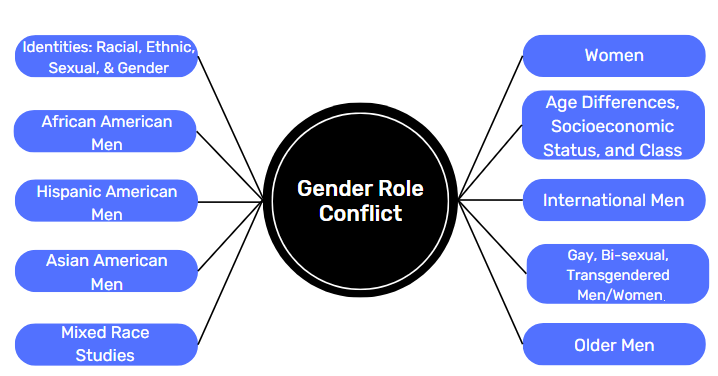
This file contains three video presentations on diversity, multiculturalism, and social-political issues. One explains the multicultural psychology of men model (O’Neil, 2015) and the second video addresses the importance of diversity and multiculturalism.
The third video discusses transnational feminism as another way to understand how masculinity issues interact with a host of socio-political and international problems that go unresolved in our world. The content in this third video is quite preliminary; therefore, the ideas about transnational feminism will require more thought and reflection.
Psychometrics of the Gender Role Conflict Scale (GRCS)
The psychometric file provides the construct validity evidence on the GRCS for researchers seeking reliability and validity information. This file has a complete listing of all the confirmatory factor analyses completed on the GRCS with diverse men, including men in countries outside the United States. Additionally, GRC norms and reliability data across various diverse samples are also summarized in this file. A summary of the dependent variables correlated with the GRC in 200 studies from 1986-2006 is presented in this file. All the moderators and mediator studies related to GRC are presented with research citations.
Click this link to jump to the first page on Psychometrics of GRCS. Note there are 9 pages in total to visit.
GRC Research Hypotheses, Questions, and Contexts To Be Explored
This part of the web page guides future researchers in conceptualizing research hypotheses using a contextual perspective. Thirty-two research questions related to GRC are presented to stimulate more predictive, moderating, mediating, and situational studies. Additionally, to generate new hypotheses, six generative contexts are discussed including these topics: macros-societal, psycho-social-developmental, multicultural & situational, gender related, research, and therapeutic/psychoeducational.
Situational Research Studies
Situational research on GRC is needed and this file has been prepared to shed light on how GRC develops and is acted out in men’s real-life experiences. The question is, “How, when, and why does GRC occur in men’s lives?” Past criticism is reviewed that suggests that GRC research has been mainly using correlational data. A rationale for situational research is presented, and conceptual research models are shown to generate more studies. Abstracts of eight empirical studies that assessed situational GRC are presented.
Seven Research Questions/Hypotheses on GRC & Empirical Evidence
This file addresses 7 research questions about men’s GRC by citing correlational, moderation, and mediation studies.
The first research questions relate to masculinity ideology and GRC statistical relationship to men’s psychological and interpersonal problems. Two other questions focus on whether both minority men and non-minority men’s GRC relates to gender role devaluations, restrictions, and violations. Another question addresses whether diversity and multicultural indices correlate, moderate, or mediate men’s GRC. The final question addresses situational research and GRC.
For researchers' easy access to specific studies in assessing these 7 questions. References are also listed.
Important Clusters/Categories of GRC Research References
Many GRC studies are now clustered into specific topic areas related to GRC. The clusters are helpful to researchers because they compile similar studies on many variables that have been significantly correlated with GRC in one place.
The four clusters are: a) Psychological Correlates of GRC, b) Physical and Psychological Health Correlates of GRC, c) Special Groups and GRC, and d) Special Topics & GRC. The arrows pointing to GRC (See Figure 1) establish that clusters of GRC empirical research studies exist on each topic. The file lists the references in each topic area for quick access to the many studies on the same dependent variable.
Psychological Correlates of GRC
This file has references to the 15 psychological correlates of GRC from published empirical studies from 1986-2013. Overall, the research provides evidence that these factors significantly correlate with GRC, with only a few studies finding non-significant results. More recent studies on these correlates are found in the published research and dissertation section of this web page.
Click here to jump to this page.
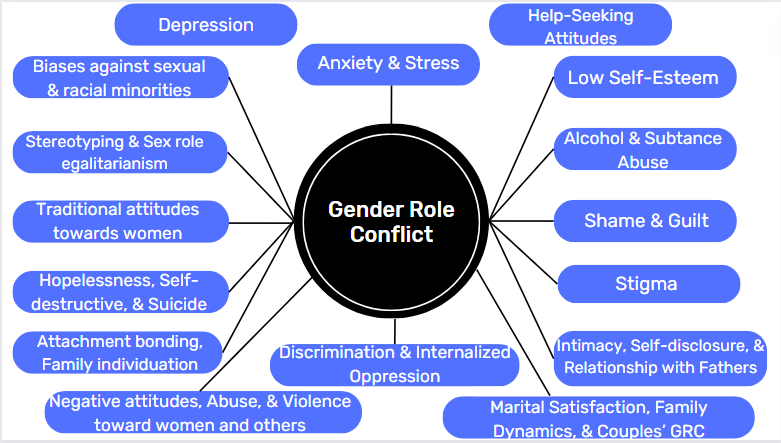
Men’s Physical and Psychological Health Correlates of GRC
This file lists references to men’s physical and psychological health problems and GRC including: violence, discrimination, gendered racism, anti-gay attitudes, internalized homophobia/heterosexism/ homonegativity, trauma, suicide, stigma and substance abuse. Many of these studies indicate that GRC is empirically related to these problem areas for men.
Click here to jump to this page.
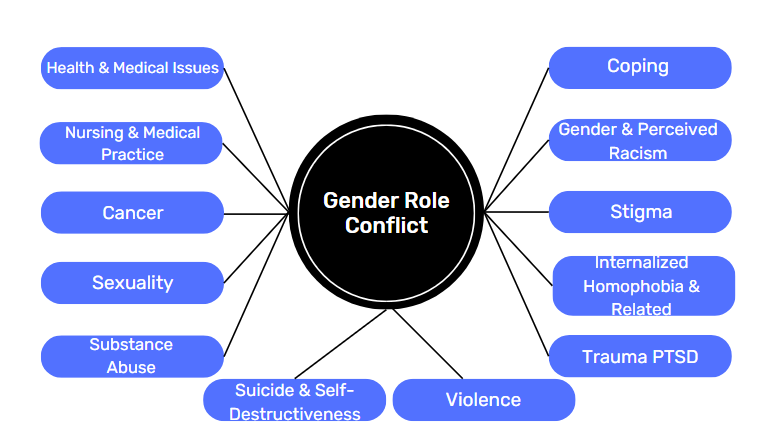
This file is also useful to researchers and clinicians studying how societal discrimination, violence, trauma, and human oppression (racism, sexism, classism, heterosexism, ethnocentrism) relate to patriarchal sexism, GRC, and people’s real pain.
The current turmoil with societal violence, racism, heterosexism, ethnocentrism, sexual orientation, and gender identity makes this file timely because the empirical evidence indicates that GRC relates to men’s health in the context of personal and interpersonal problems.
Special Groups & GRC
This file lists references for 13 groups of men, many being from vulnerable populations.
References to the couple’s GRC are also listed. Major special groups are presented in this file but not all groups of men who experience GRC.
Click here to jump to this page.
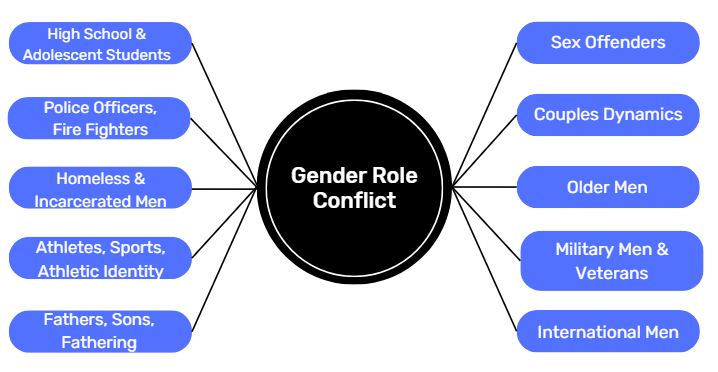
Special Topics & GRC
This file enumerates references to five important topics in men’s lives including relationships with women, children, & family; career and spiritual life; muscularity and body image; and men’s psychodynamics. These previously researched topics vary from a few studies to many.
Click here to jump to this page.
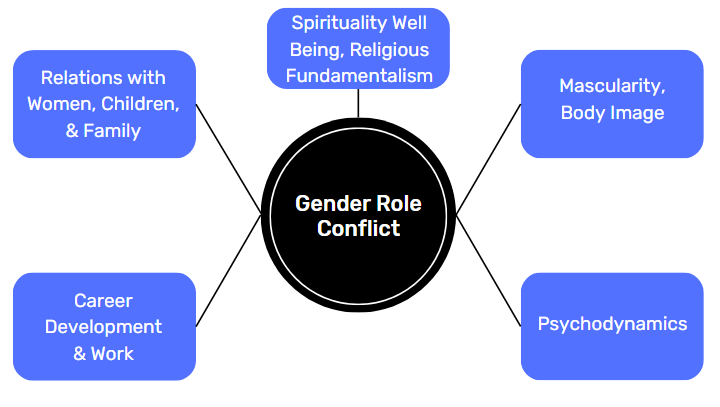
Published Research Models Assessing GRC and Hypotheses To be Tested
This file shows GRC research models and the narratives and references that describe them. Hypotheses about GRC are enumerated, and the assessment of moderator, mediator, and situational variables is discussed. These research models and hypotheses are in evolution and promote more complex research designs, specifically studies focusing on how GRC develops psychosocially and situationally in men’s lives.
GRC Empirical Research Summary Publications
This file is useful to researchers who want critical summaries of the GRC Research Program across the many empirical studies. Seven journal publications or book chapters from 1995 to 2017 provide critical summaries of past empirical research.
A video presentation “40 Years of the Gender Role Conflict Research Program,” is available with a special focus on empirical research from 2013-2016. I also provide some memories about developing the research program in this video.
Click here to jump to this page.
Published Critiques of the GRCS & GRC Theory
This file summarizes references to the past criticism of GRC and the GRCS. GRC has been of interest to researchers and is sometimes controversial and misunderstood. Over 20 critiques of GRC have been published in the literature and are listed in this file. I comment on the critiques and correct some reactions and misconceptions about GRC over the years.
GRC Clinically Focused Models, Journal Studies, & Dissertations
This file provides references on clients with GRC and the role of therapists in helping them.
A conceptual model is shown for therapists to use when assessing men’s GRC during therapy or psychoeducational interventions.
Additionally, a nine-cell diagnostic schema to assess men’s experience of GRC is discussed. Two models to assess the father’s GRC during therapy are also presented.
The file closes with journal publications and dissertations on helping men with GRC in therapy and during the therapeutic process.
Also, see the file “Gender Role Journey Theory, Therapy & Research” for more information on using GRC in a psychotherapeutic and psychoeducational context.
Psychoeducational Interventions With GRC
In this file, psychoeducational GRC programs and their evaluations are referenced. Examples of these programs are provided and references on how to help men and women with their GRC using psychoeducational methods are listed.
A video presentation about psychoeducation, (what it is and how you do it), is available for download as well as a video on how I use psychoeducation in my psychology of men class (EPSY 6304) at UConn.
Gender Role Journey Theory, Therapy, & Research
This file provides definitions and theory about the gender role journey. The gender role journey, gender role transitions, and gender role schemas are defined. A developmental model of masculinity is presented, and 50 gender role transitions across the lifespan are enumerated. The gender role deconstruction and the gender role transformational processes are defined. The published research on the Gender Role Journey Measure (GRJM, O’Neil et al., 1993) is listed.
Furthermore, the principles and parameters of Gender Role Journey Therapy are presented and include therapeutic strategies to resolve GRC patterns using the gender role journey metaphor.
The gender role journey workshop, implemented each year from 1984 to 2006, is described and the evaluations of this intervention are reported (O’Neil & Roberts Carroll, 1988).
Receiving Different Forms of the GRCS
The different forms of the GRCS (short, long, adolescent, female, etc.) are in the file. They are available for download after filling out a release form and sending it to me.
Receiving International Translation of the GRCS
The international translations of the GRCS into languages other than English (n = 20) are available for download after filling out a release form and sending it to me.
Teaching the Psychology of Men Resources
This file lists references on teaching the psychology of men and how GRC and masculinity ideology can be taught in academic classes and community settings. Seven journal articles from a special issue in the Psychology of Men and Masculinities on teaching the psychology of men are listed (O’Neil, Renzulli, & Liu 2013). Links to the Teaching the Psychology of Men Web page are found here and the work of the Committee on Teaching the Psychology of Men of SPSMM from 2003 to 2011 is discussed. Education in public schools and Higher Education on GRC and masculinity ideology is recommended to help students understand how restrictive gender roles can be psychologically and interpersonally dysfunctional.
Video Lectures of the Gender Role Journey Curriculum & Additional Information
In this section the video lectures and curriculum used to educate people about the Gender Role Journey are found. The curriculum and videos used in my course: EPSY 6304 – Psychology of Men & Boys In Counseling and Education and are available for download. Click here for the syllabus for EPSY 6304. Visit this page for videos.
Psychoeducation and GRC
Final Thoughts
Below, please see important final thoughts related to GRC.
Final Thoughts: Emerging Truths
A number of important truths emerged when revising the web page over the years. One is that human qualities are, without question, healthier and more functional than those assigned to men and women by stereotypes of masculinity and femininity that emanate from patriarchal values. Restrictive stereotypes have outlived their utility; they serve no function nor offer any survival value they might have had (assuming they ever had any) over the centuries. Restricted gender roles impede human development, dehumanize both men and women, and, under many circumstances, victimize men, women, and children.
Unfortunately, political, economic, and religious factions that want to control human behavior and set society’s priorities according to repressive ideologies that endorse restricted gender roles are active in their antifeminism and endorsing sexism. Before feminism, no collective consciousness existed about the perils of sexist stereotypes that cause GRC . There has been some progress over the years, but even now public awareness of the peril of sexism appears to ebb and flow based on social and political dynamics in our society. Only a persistent and critical deconstruction of these damaging stereotypes in patriarchal societies can reverse the negative effects of sexism, GRC, and restrictive gender roles in people’s lives.
My position is that gender role conflict is dehumanizing to both men and women. GRC is one way to explain the dehumanization and promote social and political change.
The greatest obstacle to the change in gender roles is a failure to see men (and women) as full human beings. In psychology, men have been studied not as gendered human beings, but as generic persons based on stereotypes (Kimmel, 2011; Smiler 2006). The study of men as gendered human beings is a relatively new phenomenon in psychology. Men’s GRC has gone unexplored because men’s lived experiences with gender roles have not been theoretically and empirically studied.
Final Thoughts: What Is At Stake?
At the end of this introduction, I want to be clear about what is at stake in researching GRC.
Sexist, restrictive, and oppressive stereotypes of masculinity and femininity no longer sustain the human race. Patriarchal sexism and stereotypes are outdated, dangerous, and potentially violent. The evidence is everywhere whether it be: the epidemic violence against women and men; bombs destroying a whole nation in Europe and the Middle East; famines in Africa; addiction and sexual violence; climate change denial; and the mass shooting every day in America.
At the macro-societal and the micro-interpersonal levels, GRC needs to be understood as part of the societal violence, social injustices, and polarization in our society.
Some or maybe much of the violence is about patriarchal sexism and the male gender role. My analysis of the data and my clinical experience support this categorical statement but everyone needs to determine their own position on these issues.
What can we do? Certainly, more research on men and more effective programs to help them are critically needed.
The patriarchy is unlikely to be dismantled without factual knowledge about gender roles from the social sciences. Documented GRC needs to be part of the discussion. Furthermore, consciousness raising about gender roles need to be an educational priority and translated into action plans if gender justice is to occur in our democracy.
Moreover, we need to listen to each other more and find common ground to dialogue about gender roles. The factual knowledge about gender roles from the social sciences must be part of this dialogue.
Without question, talking about gender roles is highly controversial and politically polarizing in 2024.
In some states of our country legislation is being passed to prohibit the very discussion and study of gender roles recommended with this web page.
Books are being banned and teachers are being threatened for what they teach. This kind of censorship is the antithesis of our democratic principles and a real masculine threat.
For these reasons, I invite you to get involved in any way you can. Let me know if I can help.
I hope this introduction to the web page is useful to you in planning research studies, doing therapy, or psychoeducational programming. I want to thank the hundreds of friends, colleagues, researchers, and their mentors for the many contributions to this research database. I take credit for starting this research program. However, the success of the gender role conflict research program surely belongs to the hundreds of graduate students and researchers who conducted the research over the last 40 years. I want to thank each and every person who believed that we could assess men’s gender role conflict through the Gender Role Conflict Scale.
Acknowledgements
With a research program that spans five decades, I have many people to thank. My specific acknowledgements are detailed in chapter 2 of my book (O‘Neil 2015). Hundreds of colleagues are identified, who published their studies or made major contributions to the research program over the years. I thank everyone who believed that GRC research could be measured and argued that GRC was a reality in men’s and women’ lives that deserved dialogue, discussion, and future research. These researchers deserve much of the credit for the research programs growth over the years.
Creating this web page was complex and challenging. Lauren Dougher, doctoral student in Educational Technology at UConn, deserves much credit for designing this web page. Her technical skills and advice made the web page "come alive" with information for future researchers and clinicians. I appreciated her guidance and expertise in helping me summarize the GRC research program on this web site and make it more accessible to the public.
Barbara Helms, Ph.D. also provided excellent editorial assistance and review of the many files while revising the web page. Barbara co-edited with me the Sex Roles journal manuscript (O’Neil, Helms, Gable, David, & Wrightsman, 1986) that documented the psychometrics of the Gender Role Conflict Scale (GRCS). Her help again 40 years later is highly valued and appreciated.
Both UCONN and the University of Kansas provided research grants that both helped initiate the research program and support its longevity over the years. The Society for the Psychological Study of Men and Masculinities (SPSMM, Division 51 of APA) have been a strong supporter of GRC research by accepting our convention symposia proposals and publishing empirical research in the journal, Psychology of Men and Masculinities.
The most authoritative statement on men’s gender role conflict is found in a chapter of my book: Men’s Gender Role Conflict: Psychological Costs, Consequences, and an Agenda for Change (O‘Neil, 2015). The first chapter: “A Call to Action To Expand the Psychology of Men” conveys the importance of GRC and why it matters to study GRC and create programs to help men and women journey with their gender roles. Those 28 pages summarize what is at stake with men’s GRC and complement my updated ideas found on this web page. You can read the chapter below.
Book Chapter: A Call to Action
 Loading...

 Reload document
  Open in new tab
 My biography, vita, contact information, and retirement statement are also found below in the drop down boxes.
Biography
James M. O’Neil, Ph.D. is Professor Emeritus in the Department of Educational Psychology at the University of Connecticut and was a licensed psychologist in private practice in South Windsor, Connecticut from 1984-2021. He taught at UCONN from 1982-2025. In 1975, he received his doctorate from the Department of Counseling and Personnel Services at the University of Maryland. He is a fellow of the American Psychological Association in Divisions 17 (Counseling Psychology), 35 (Psychology of Women), 43 (Family Psychology), 51 (Psychology of Men), 52 (International Psychology) & 56 (Trauma Psychology). . He is one of the founding members of the Society for the Psychological Study of Men and Masculinity (SPSMM), Division 51 of the American Psychological Association. SPSMM named him Researcher of the Year in 1997 for his 20-year research program on men’s gender role conflict. His research programs relate to men and masculinity, gender role conflict, psychology of men and women, and violence and victimization. He is the author of the Gender Role Conflict Scale, a widely used measure of men’s conflict with their gender roles. His book (with Michele Harway) “What Causes Men’s Violence Against Women?” (Sage, 1999) has been translated into both Japanese and Korean and his most recent book “Men’s Gender Role Conflict: Psychological Costs, Consequences, and an Agenda for Change” was published by the American Psychological Association in 2015. He has published three books and over 150 journal publications and book chapters. In 1991, he was awarded a Fulbright Teaching Scholarship by the Council for International Exchange of Scholars, to lecture in the former Soviet Union. He lectured at Moscow State Pedagogical University from February through April, 1992, on such topics as psychological counseling, psychology of gender roles, and victimization/trauma. In 1995, he was awarded Teaching Fellow status by the University of Connecticut for his outstanding excellence and dedication to the university teaching profession. In August, 2008, he received the Distinguished Professional Service Award from Division 51 of the American Psychological Association for his 25 year research program on men’s gender role conflict and his advocacy for teaching of the psychology of men in the United States. He has advocated for professional activism with gender role and social justice issues throughout his 50 years as a counseling psychologist.
Vita
Loading...
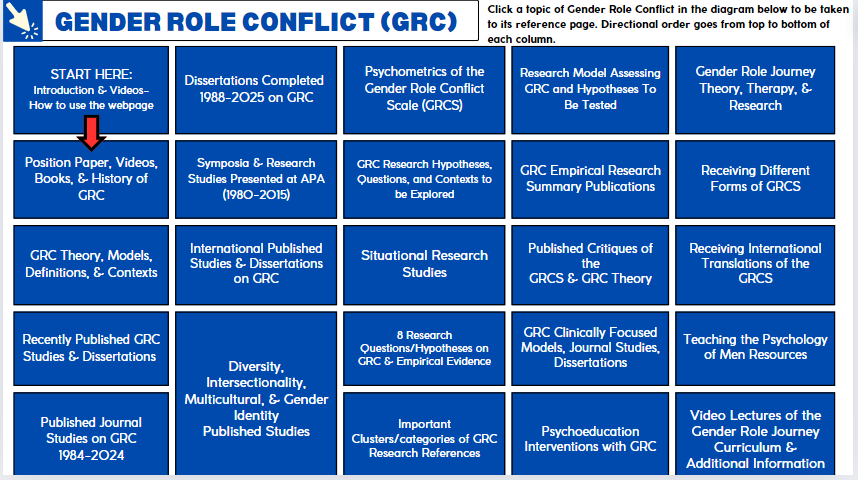
Retirement Statement and Videos
Article by Mikala Kane-Director of Communications and Digital Strategy, UConn, posted April 21, 2025:
After many years of dedicated work, Dr. O’Neil will be retiring at the end of this semester. Dr. O’Neil has had a huge impact on the Educational Psychology department here at UConn and has inspired countless students with his psychoeducational teachings. Here is a statement from him reflecting on his years here at the University of Connecticut:
I will retire on June 1, 2025, after 43 years at UConn and 50 years of university teaching, research, and service. My departing message is immense gratitude to all my past and present students, my colleagues in school counseling and EPSY, and the professional staff across the UConn campus. This is my way of saying farewell: an expression of goodwill, acknowledging that you all will be missed.
I have loved working at UConn. Those six words say it all!
No one stays in a single professional setting for 43 years unless they are engaged, satisfied, and excited. The excellent students, the brilliant faculty, and the supportive staff across campus have helped me immensely. I appreciate all the support and resources that I have received.
To contextualize my time on campus, here is a summary of my academic positions at UConn, my future plans, and what I leave behind.
Brief Career History
Before coming to UConn, I worked at the University of Kansas (1975-1982) as a faculty member in their Counselor Education and Counseling Psychology Programs and as a psychologist and Assistant Director in the Counseling Center.
After earning tenure at Kansas, I moved to UConn in 1982 and was Program Coordinator of the Counseling Program from 1982-1988, adding 7 new courses to the counseling curriculum that needed updating.
In 1990, I was invited to join the School of Family Studies (now HDFS) and spent 17 years there. The HDFS Dean asked me to develop a diversity/multicultural curriculum and teach courses on counseling, violence, and gender roles. Working with the HDFS faculty, we created a Diversity Committee and developed a diversity curriculum, specifically a required course on diversity and other classes on race, class, gender, and other multicultural indices.
In 2006, I was invited back to the Neag School of Education in the Counselor Education Program to help with CACREP accreditation and teach courses in human development, career development, and the psychology of men. Over the years, Neag had become a center for educational excellence and I wanted to be part of it and contribute in any way I could.
The past 18 years in EPSY have been very good for me! To join committed, caring, and generative scholars and energetic students was a perfect way to finish my career. Thank you, UConn, for allowing me to work in various departments where I could make the most difference.
What Am I Going to Do in Retirement?
The looming question to most retirees usually is: “What are you going to do in retirement?”
I have moved to Narragansett, Rhode Island, to be near the ocean, the waves, and sea air. I did my last sabbatical there and never left. This coastal community is where I can grow, stay healthy, work on my research, develop more leisure activities, and become more spiritually grounded. Living a half a mile from the sea has been restorative and permanently altered me; something that I am also grateful for. I will continue to work on my gender role conflict (GRC) research program and maybe write another book on men and finalize a few unfinished papers on psychoeducation, violence as mental health issues, inter-generational trauma of my famous ancestors, and my gender role journey concept. I will also be doing more gardening. Like my mother, I am good with geraniums.
What Am I Leaving Behind?
The answer to this question is a lot for sure!
There will be many memories about UConn to sort through. Like most retirees, there will be substantial loss of primary identity indices and professional roles. These losses will be challenging, but I am looking forward to helping people outside my faculty and private practice roles.
The most concrete thing I am leaving behind is my Gender Role Conflict Research websites: James-oneil.scholar.uconn.edu or Genderroleconflictresearch.com.
I have been updating this webpage for the last four years. It is not your typical faculty web page with a biography, a picture, vita, and publications. This web page summarizes in one place the theory and research on men’s gender role conflict (GRC) over the last 45 years. Twenty-four separate files summarize the 600 empirical studies that have utilized my Gender Role Conflict Scale (GRCS) over the years. The web page includes 900 references to men’s GRC, the psychometric and construct validity evidence on the GRCS, and 2 dozen video lectures from my classes on gender roles, diversity, and positive mental health. I also give commentary on what is “at stake” with men’s GRC and what needs to be done next. I am hoping that the web page will be useful to future researchers, teachers, and clinicians. What I have done with my research and teaching at UConn is what I leave behind on this webpage.
Gratitude Is My Farewell and Departing Message
Studies have demonstrated that expressing gratitude reduces envy, anxiety and depression and increases self-esteem, life satisfaction, and makes us more resilient. Therefore, gratitude is the perfect human quality to mention at the end of my career here at UConn. My gratitude is to the thousands of students that I have taught and many talented faculty colleagues and the professional staff that I have interacted with. I am very grateful to every student I have had in class. Students have given me so much energy and stimulating ideas over these many years. They have kept me engaged, alive, and healthy. Moreover, my current colleagues and staff in EPSY have been the best faculty that I have joined in my 50 years of university teaching. It has been a blessing to teach in this generative department. Thank you all!